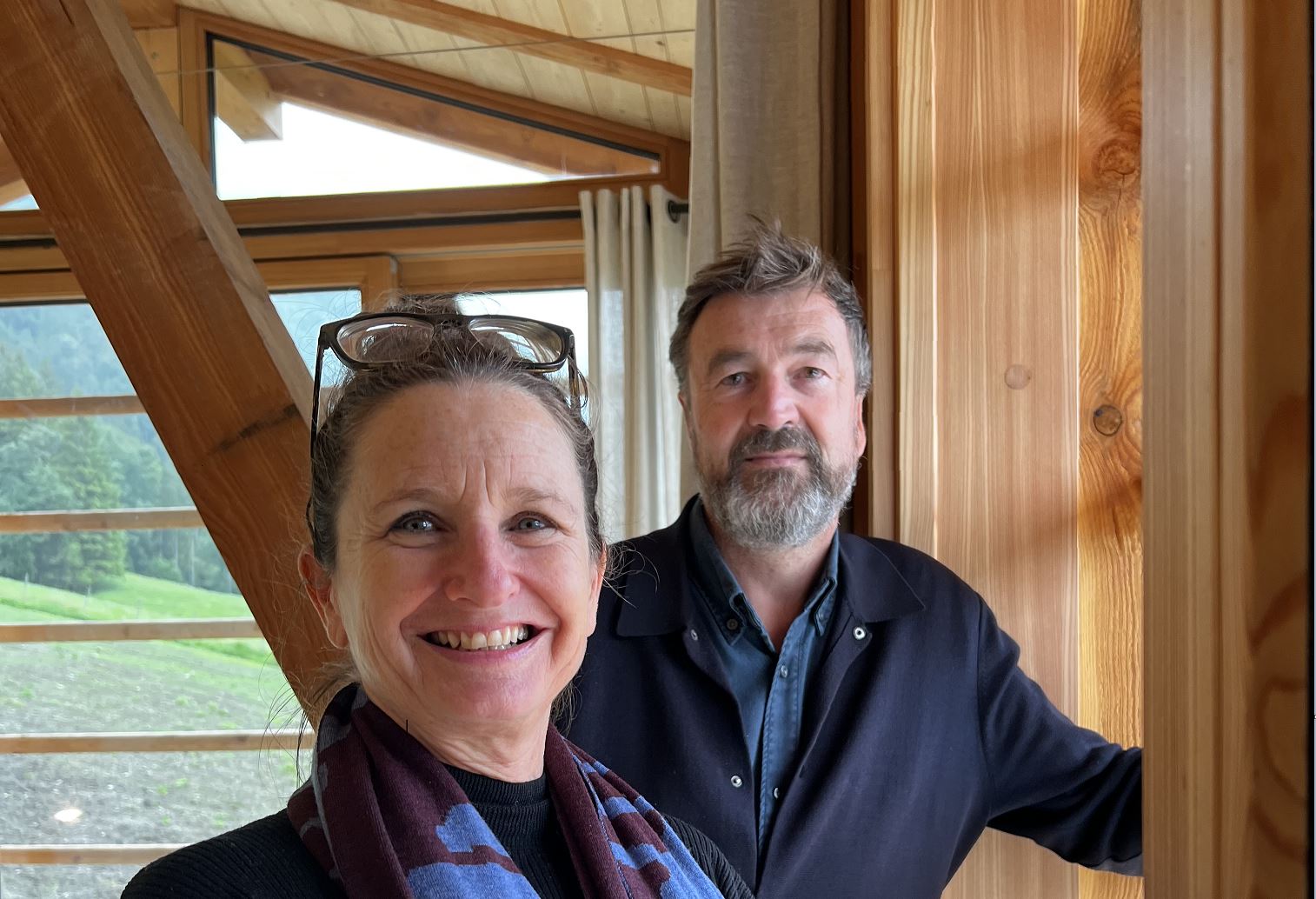
The Tannerhof in Bayrischzell continues to grow — and remains true to itself. More than ten years after the last major renovation, a new building has emerged that feels at once pared back and richly layered. In conversation with the client, Burgi von Mengershausen, and the architect Florian Nagler, it becomes clear: this is not about spectacular gestures, but about the essential.
A long shared history and shared values in working together
How does it feel for you to be completing a new project at the Tannerhof?
Burgi: It's very moving. We've known each other since 2007 and realised our first major project in 2011. After all this time, the question came up: should we continue with the Badehaus — originally conceived as the second step of the larger renovation. In the end, something quite different came of it, but something very beautiful and deeply touching. I'm absolutely delighted by that.
Florian, you are the architect of the entire project. How does it feel for you?
Florian: The Tannerhof really is a special project, because, as Burgi just said, we've been involved with it for a long time. The last time, it took us four years from first meeting to completion. This time, too, we took our time and weighed up many different options. I'm very glad that, in the end, it became precisely the solution we have now built. Because this house simply fits the Tannerhof wonderfully.
What was the appeal back then, in starting the Tannerhof project?
Burgi: The wonderful clients, of course! (laughs)
Florian: Building is a matter of trust. When you take on a project together, the chemistry between everyone involved has to be right. You need the feeling of having shared interests and working towards the same goal — I had that feeling pretty quickly. Then it becomes a wonderfully rewarding task, especially in such a striking landscape. The existing building was a challenge: a structure with a hundred-year history, continually built on and developed over the decades. The crucial question for me was: how do we build today, in the countryside? How do we create something that fits a rural setting without denying that it has been made in the here and now?
The existing building was a challenge: a structure with a hundred-year history, continually built on and developed over the decades.
What shared values connect you?
Burgi: Being free of conventions, and the ability to think in unconventional ways. That binds us strongly. Developing something new, like the idea, back then, of building towers instead of further huts. That was exciting: going upwards without sealing more ground. Then the love of wood as an extraordinary building material, the love of simplicity, and the principle of "less is more." We share all of that.
Just as important is developing things together. We didn't train as hoteliers — we're really doctors. And for you too, Florian, it was exciting, because you said: "I haven't built a hotel before." So we both stepped into something new, where we could learn together. And, not least, what binds us is humour.
Florian: You also have to be able to laugh at yourself. That's tremendously important. "Together" — that's exactly the right word. We're each willing to accept what the other brings into a project. But at the Tannerhof, it's particularly so: afterwards, you can say it would never have turned out this way without these clients. As an architect, you can't "give birth" to such a project on your own; it grows out of dialogue.


From the grand plan to the essence — the art of leaving things out
Burgi, when was the moment you sensed: now is the time for something new again?
Burgi: That was around 2018. We had completed the first renovation in 2011, and even then it was foreseen that the Badehaus would be renovated and improved as a second step. Already then we were considering whether an outdoor pool wouldn't be lovely.
So began another playful exploration of ideas, and over the years more and more was added. At one point we were even considering changing something in the east wing of the Neue Tann, and wondering whether we still really needed the indoor pool.
Everything had been planned through, until a pandemic stopped us in our tracks. Then came further crises, supply shortages, enormous cost increases. At some point we stood before an overall concept that was no longer affordable. So we pulled the emergency brake.
In the end, what we've now built is the essence of all those grand plans. And I'm very pleased about it, because it feels right and is simply Tannerhof at its core.
With projects like this, you sometimes need time to ask: does this really still suit us?
Florian: The essence is good, and I'm genuinely glad that much of what we had planned along the way was, in the end, not built. It was something like reducing by simmering — ever smaller, ever more fitting. Sometimes it's an advantage when there isn't enough money: you think twice about what you really need, and you build only what is important and essential. On the door of the farm shop is the line: "Mensch, werde wesentlich." ("Become essential.") I've kept that thought in the back of my mind throughout our projects here.
How did you come to take the Harpfe as your starting point?
Florian: As I understand it, the Harpfe comes from agriculture: a wooden frame used for drying hay or storing other things — an open construction with a protective roof above. I think we got onto the idea through Roger. He had always wanted a Harpfe, and I also found it a very beautiful theme.
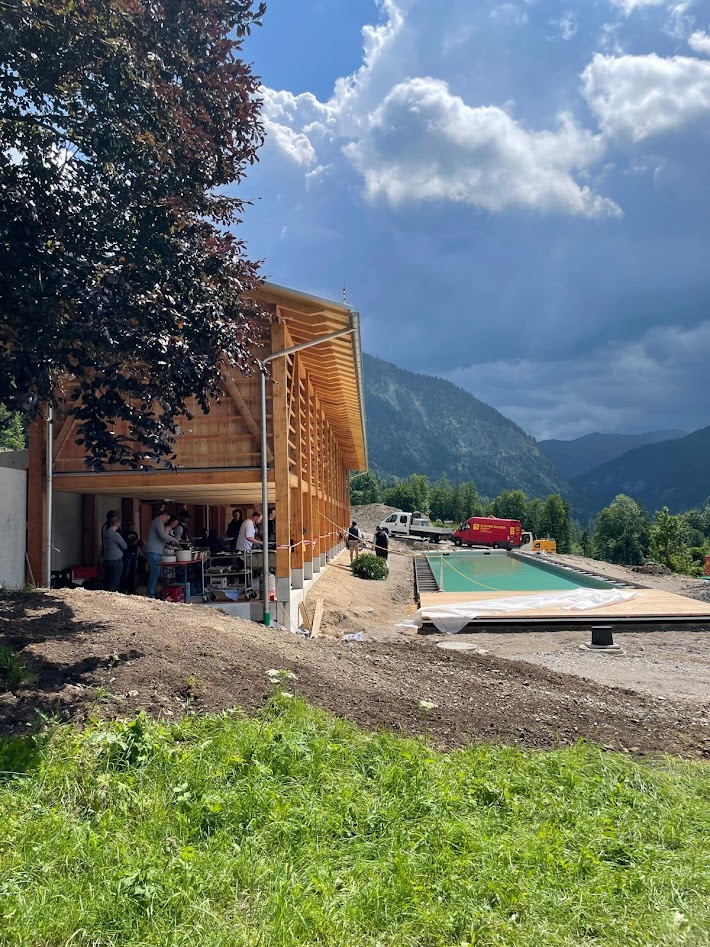
With the Harpfe we really did begin in a quite reduced way: just with the roof. Step by step, elements were added — the lovely quiet room, the sauna on the other side. Even so, the whole thing has kept the character of an open frame with a sheltering roof — a strong element in the landscape.
Burgi: We have a long affinity with the Harpfen. We first discovered them in Carinthia and East Tyrol. Archaic structures that simply stand there as a matter of course, without overwhelming or hiding nature — on the contrary, intensifying it. That is exactly what's been achieved here: an architecture that intensifies the experience of nature and creates new images.

Looking ahead
Burgi, is the Tannerhof project now complete for you?
Burgi: The Tannerhof is, in fact, never finished. It is always a process, and a multi-generational task. We are now the fourth generation here, and it will continue. When we had reduced the planning to the essential, it was our son Jonas who said: "You absolutely have to put fitness rooms in there. If you don't, you're really being stupid." And he was right.
For the next generation, who will work and shape things here, there will always be new tasks: cabins to be renovated, rooms to be renewed. Alongside architecture, the question of energy is, of course, a very important one for setting up the Tannerhof for the future.
I hope our guests are moved in a way similar to me.

When the project is finished and the first guests are using it — what is your wish?
Florian: Honestly, I don't have any particular wishes. You don't necessarily have to want your buildings to achieve something specific. People are so different; they perceive spaces in very different ways. Of course it would be lovely if they feel at ease here and experience it as something that enriches the Tannerhof.
At its core, it's something small: a wall, a few rooms behind it, a wooden frame in front and a swimming pool. Nothing huge or spectacular. But it creates and offers an incredible range of different situations. For example, I'm sitting here now in the quiet room, watching the clouds drift across the mountain — you could sit for hours.
For all the reduction, in the end something multi-layered has come into being.
Burgi: I hope our guests are moved in a way similar to me. Just to sit here, to be present — without consciously noticing what's happening to you. Simply to look out and think: "Wow, isn't that beautiful. Wonderful that something like this is still allowed to exist."