How long have you been practising art therapy at the Tannerhof – and how did the studio come about?
I came to art therapy because the art business frustrated me. After finishing my art degree, I spent several years engaging intensively with the commercial side of art, with marketing. But what really interests me – exploring and living out creative processes themselves – fell by the wayside. Art therapy was really taking off in the 1990s, so I got into it then, and I’ve never regretted it.
My own artistic work keeps developing alongside it, so I’m fortunate to be able to integrate art and therapy into my life – that’s a deeply creative process in itself.
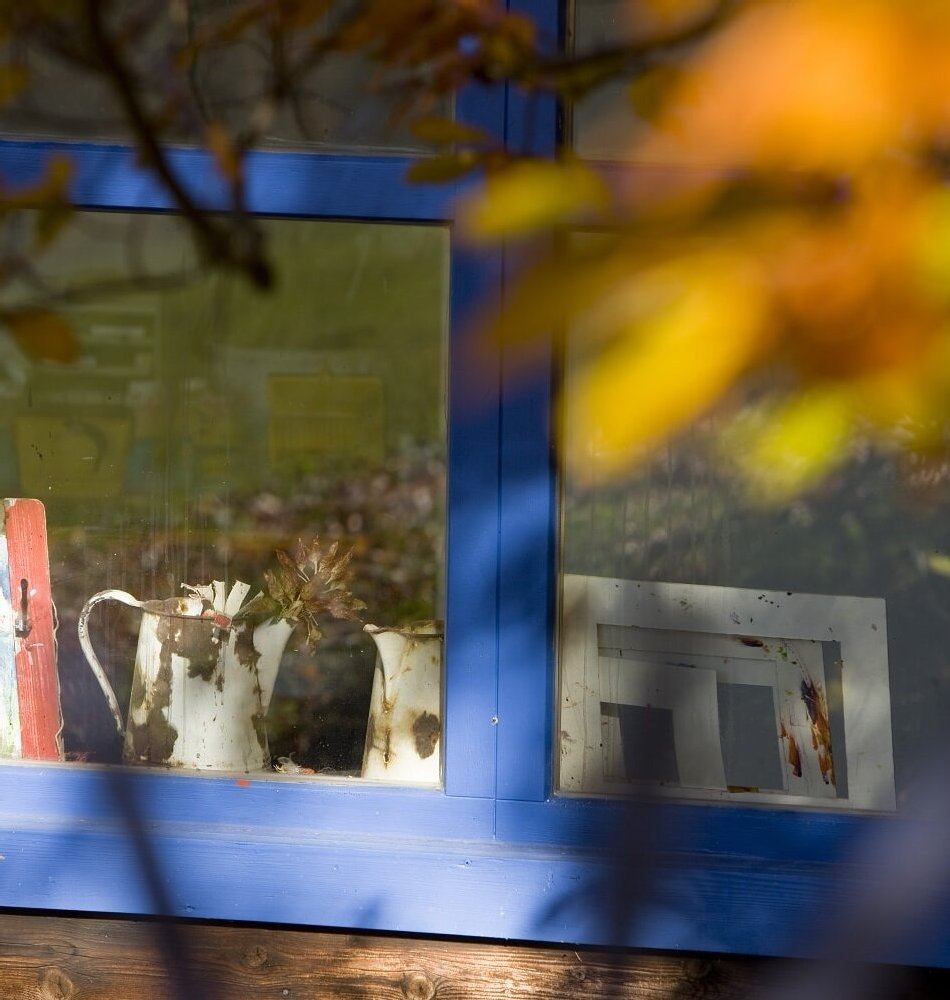
I’ve been bringing creative, therapeutic approaches to the Tannerhof since the 1990s. The studio originally served a completely different purpose: it was a junk room, a party shed, and earlier still an open-air rest hut for people with lung disease, who strengthened their immune systems here, wrapped in blankets while fresh air streamed through the open windows. The room lay unused for a long time, until I was given the chance to convert it into a studio – with running water, a toilet and, above all, a stove. Because in winter it matters that the people who come here feel cared for. The little fire I light an hour before the session in winter creates not just warmth but an atmosphere that greets you at once: “Oh, how lovely.” It’s as though it lights a creative spark in people, too.
The little fire I light an hour before the session in winter creates not just warmth – it lights a creative spark in people, too.

What are the philosophical principles that shape your art therapy?
Creativity is a universal resource that we all carry within us – even Stone Age people painted. For me it’s mainly about self-expression and a focus on resources. I work with what is there, not with what is missing. That means we concentrate on uncovering again what people already carry inside them. There’s real power in people sensing what belongs to them and, in the end, holding something in their hands that they created themselves. A picture is more than a feeling – it’s a testimony you can see and touch.
Neon colours are very popular right now. To me that’s an expression of how overstimulated our society has become.
That’s why I don’t interpret anything at first; instead I ask questions: “What was there as you painted? How did you begin, what was your process like, how do you feel now?” I deliberately avoid value judgements, or I point out self-critical language like “I can’t do this” or “I’m no professional.” Every picture is a resource. That’s a core principle of art therapy. Every picture carries a message that represents a resource – a way the person can deal creatively with a problem.
What does a session with you look like?
Every session begins with a simple question: “Is this about an artistic interest – do you want to learn something, express something – or is there a problem in your life you’d like to look at through this medium?” That’s how we work out together what it’s about. The time is limited – 90 minutes – which is actually quite a lot, but people first have to warm up to the medium. While they paint, I offer impulses, but without steering. Sometimes I interrupt: “Is that finished already?” – and often the answer comes back: “No, there’s more to come!” Or I help with mixing colours, when someone has already mixed half a bucket of pink, say, without being happy with the shade. Which colours people choose is interesting in itself: neon colours are very popular right now. To me that’s an expression of how overstimulated our society has become, to put it bluntly. The contrasts have to be cranked up so high just so that anyone still looks. And that sometimes makes me a little sad, because there are such wonderful earth pigments, but they fall completely by the wayside.

What happens to the pictures in the end?
Most people take their pictures with them – and are glad later when they hang them up at home. Others destroy them, for example when someone has released a great deal of anger. That’s the beautiful thing about painting: you can put that feeling onto the paper, without hurting anyone in the process. Sometimes the wish then arises to burn the picture or tear it up. That need is consciously acknowledged, and when it comes, it’s allowed to happen. When pictures are forgotten or left behind, I dispose of them after a while.
How do you work with people who are afraid of the blank page?
I encourage them to simply begin – with their eyes closed. “Take the brush, dip it in the paint, breathe in, and as you breathe out – bam, onto the paper.” And then you open your eyes and see what happened. That’s a first step, and it takes courage. For people with a strong need for control in particular, it’s a liberating experience.
In which situations in life does art therapy help most?
Art therapy speaks to people in very different situations: people in grief, working through a heavy loss; people with suppressed anger who want to give their rage an outlet; or people with depression who want to find their way back to their feelings. I also regularly accompany people experiencing burnout – painting is a fixed part of our burnout programme here. And then there are simply people who like to paint – who come without any particular reason, to discover their creative side or reconnect with it.
And do you know what the loveliest thing is? Time gets forgotten. Suddenly someone says: “Over already? I feel like I’ve only just started!” – a sign of how deeply painting puts you into a state of flow. It’s restorative and gives people back something that often gets lost in daily life: the experience of being in the here and now.


Is there something you keep impressing on your participants?
Yes: ‘Embrace the gifts of chance.’ That’s a principle I keep emphasising. Many people say: “But that was just chance, I didn’t do that at all!” And I insist: “No – that’s your subconscious revealing itself. Let these messages in; they don’t have to be put into words straight away. But let them out, so you can see them.” They’re usually incredibly potent messages that slip out there.
Embrace the gifts of chance.
Painting is different from writing – it’s more direct, freer, less controlled. At school we learn to form letters, to build sentences. But here it’s not about technique or grammar. It’s about spontaneous self-expression. And that’s what matters most.