There is, at the Tannerhof, that one moment shortly after sunrise when the valley is still quiet, the mountains in the backlight slowly begin to glow, and the meadows below the farm lie in a green so saturated that it almost feels too rich to be real. Then it lies there, down below in the middle of the meadow: a long, calm strip of stainless steel, twenty-five by five metres, and within it, completely still, the reflections of the slopes are gently rocking. Anyone who steps out of their room at that hour, who crosses the meadow before the house has woken up, knows without words: something has come into being here that gives the summer something to hold on to.
The Badeharpfe — that's the name of the building — needs no big words. It is, if you like, a roof on legs. An archaic timber frame of a kind known for centuries in the eastern Alpine region: in Carinthia, in East Tyrol, in Slovenia. There, on such structures, hay and grain are dried; light and air do the work. At the Tannerhof, the world's probably first Harpfe in which one bathes, sweats and rests has now come into being. Florian Nagler, this house's architect for nearly twenty years, has described its origin precisely: an open frame with a sheltering roof, simply belonging where it stands, parallel to the contour lines. Burgi von Mengershausen, who runs the Tannerhof in the fourth generation, puts it more directly: an architecture that intensifies the experience of nature and creates new images. That is, in the most generous sense, an understatement.
The mountain, the pool, the light
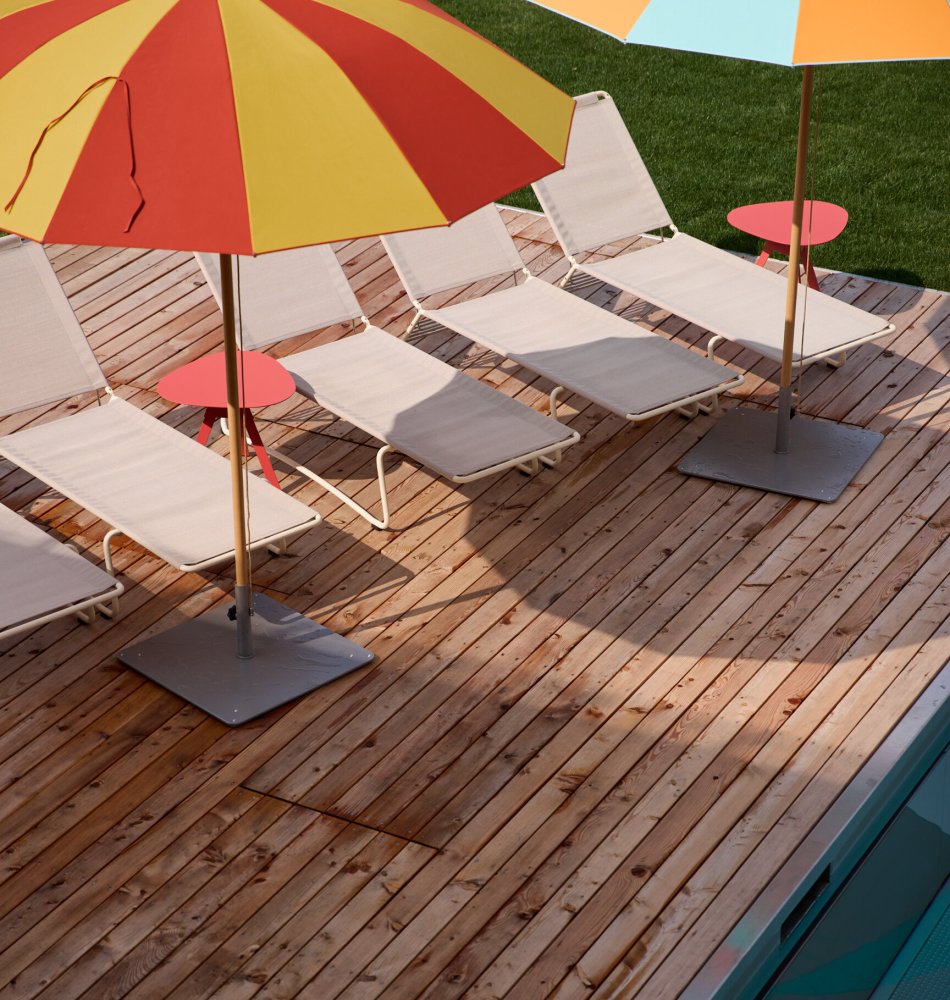
Twenty-five metres of stainless steel, naturally cleaned, heated from April to October. That's how the data sheet reads, and that's how little it tells. Anyone swimming the first lengths grasps at once why this pool here, in front of the Harpfe, is so important. It isn't the warm water that makes the difference, but what happens above it. With every breath, the gaze rises up the Seeberg; the rafters of the Harpfe frame it like a painted print; and the water itself is so clear that you see your own shadow dancing on the bottom. Around the pool stand loungers with colourful parasols, gently knocking in the light summer breeze. Summer at the Tannerhof in 2026 means: out of bed, across the meadow, into the pool. Somewhere among the trees a bird is calling while, metre by metre, you draw yourself into the day.

In winter, it gets icy here. Then the pool becomes an ice basin, the mountain air bites at shoulders and collarbones, and the sauna above suddenly is no longer an amenity but a rescue. But now, in summer, everything is allowed to slow down.
Nothing huge, but an incredible range of situations
In conversation with Micol Krause, Florian Nagler said one sentence that captures this building precisely: "At its core, it's something small: a wall, a few rooms, a wooden frame in front and a swimming pool. Nothing huge or spectacular. But it creates and offers an incredible range of different situations." Anyone who spends a day at the Harpfe begins, at some point, to enumerate them. The shaded lounging side beneath the roof, where you lie after a swim while the mountain shimmers in the air. The quiet room on the upper floor, scented of wood, glazed all around, with Weißhäupl Maliha loungers from which you watch the clouds drift across the slope. The other staircase, up to the Finnish sauna, behind whose large panoramic windows the entire valley and the Wendelstein lie. The two fitness rooms, half dug into the slope, with the tall parapet beyond which a strip of meadow stands, as if it wanted to look at you.
The idea of arranging all of this on a single axis comes from a long, crisis-marked planning history. Once, a new Badehaus was envisaged, a drained indoor pool, a pool restaurant on a grand scale. Then came pandemic, supply shortages, exploding costs, and things had to grow smaller. Nagler calls that "reducing by simmering"; Burgi calls it "the essence." Both mean the same thing: leaving out, until only what holds remains. On the door of the farm shop has stood, for years, the line you don't need to explain at the Tannerhof: "Mensch, werde wesentlich." The Harpfe is, looked at very closely, the architectural answer to it.


A day that finds itself
A summer day at the Tannerhof follows no agenda, and that is exactly its luxury. It usually begins on a spot with a view. A coffee or tea in hand, deep breaths of mountain air, watching the meadows wake up slowly. Then the first lengths in the pool, before the breakfast buffet has even been laid out, and afterwards, hair still damp, the small, refined breakfast in the Alte Tann. Bircher müsli, organic yoghurt, cheese from the Tegernseer Naturkäserei, bread from the Bayrischzell organic bakery, coffee from the Dinzlers, tea from Herbaria. Nothing about it is loud. All of it is good.
The morning belongs to movement. Whoever wants, walks the Seeberg round, one of the most beautiful hikes in the area, which Romy von Mengershausen herself counts among her favourites. Whoever wants to go higher, hikes the König-Maximilian-Weg towards the Wendelstein, brushes past the Wendelstein alpine pastures, stands up there at some point and sees how the Leitzach valley lies beneath you. Whoever prefers to stay below, walks flat through the valley, alongside the brooks where, now and again, beavers settle in and rewrite the landscape in their own way.


GENUINE HANDCRAFT
Back at the farm, the other Tannerhof skill awaits anyone who wants it — the kind that the open-air summer can easily overshadow. The Badehaus has been the therapeutic heart of the house for generations, and it stands on two legs: medicine and craft.
On the medical side, Burgi von Mengershausen, a specialist in general medicine with additional qualifications in naturopathic medicine and nutritional medicine, and her colleagues Alexa Kaiser and Gabriele von Bergmann are already continuing the fourth generation of doctors at the Tannerhof. The principle of these consulting hours is, at first glance, unspectacular and, at second glance, radical: first, you listen. Then, you talk. Only then, you treat. The services range from the in-depth health examination through laboratory work, ECG and ultrasound to IHHT altitude training and ozone autohaemotherapy. All without haste. All after conversation, and always personalised.
Beyond that, another treasure house opens up: more than fifty treatments that have shaped the Tannerhof for over a hundred years. A classic full-body massage in which head, neck and back receive everything that everyday life has dragged in. A fasting massage that calms abdomen and head at once. A Kneipp contrast affusion, as old as the method named after it, and as enlivening as if it had been invented today. A moor pack whose warmth still sits in the legs hours later. Alongside, the facial and body treatments with natural cosmetics, peelings with alpine herbs and sesame oil, a honey massage that sounds Bavarian and is, in truth, detoxifying. And, with a lovely bridge over to the Harpfe itself, the hay-flower wrap. On the Harpfe in the Alpine region, hay is dried; at the Tannerhof, that very hay, wrapped in a fleece, warms the fasters' livers. Naturopathy calls it "the morphine." Whoever has lain under such a wrap once, knows why. On the noticeboard, in large letters, two words: GENUINE HANDCRAFT. That is exactly how it feels.


And then there is the weekly programme. Six days a week, mornings and late afternoons, an offering as broad as the house itself. Yoga on the sun deck in the woods, with views of the slopes. Feldenkrais in the seminar room, so subtle that you only notice on standing up what has happened. Tai Chi outside, when the weather plays along. Pilates, stretching, theraband, autogenic training, Nordic Walking, aqua fitness in the indoor pool. Alongside that, almost daily, a guided hike through the Leitzach valley or up into the mountains. A few steps over the slope lies the old studio, once a rest hall, today the workplace of Nele von Mengershausen, artist and the soul of the house, with painting groups and art therapy for those who, just then, are missing words — or have too many of them.
Midday and afternoon
Lunch at its best is taken outside. Whoever is enjoying "Three-Quarter" Half-Board takes from the Salad'n Sound buffet, which takes its name seriously and offers a selection of salads, good oils and organic produce. Whoever has chosen the "Schlanke Tanne" gets a three-course low-carb menu, which head chef Elias Lang composes with no mercy for pasta but great delight in vegetables, fish and the right fats. And whoever is fasting takes a mild vegetable soup, in calm, in the faster's room.
After that, the Harpfe's true hour begins. When the sun has already moved on and the timber casts long shadows across the sun deck, the loungers by the pool turn into an open-air reading room. Some swim lengths; others stand at the shallow end and look; still others climb the stairs into the quiet room and disappear for two hours. Florian Nagler put it himself, in the interview: "For example, I'm sitting here now in the quiet room and watching the clouds drift across the mountain. You could sit for hours." It is no coincidence that he, of all people, says this. The room is built for exactly that.

I watch the clouds drift across the mountain. You could sit for hours.
Around seven, just before the kitchen carries out the first plates, the light shifts. The wood, restrained during the day, takes on a colour you'd describe most readily as honey. The Wendelstein stands in the backlight. The parasols by the pool are still open, although they're long since not needed. In the Finnish sauna, right at the top, eighty-five degrees are measured; the panoramic windows are quietly sweating with you. You sit, breathe, fall silent. Afterwards: down the stairs, a quick run across the meadow, a leap into the now lukewarm water. And then, who knows, a second time.
Later, guests gather in the Alte Tann for an apéritif, followed by the menu du jour. Three to five courses, depending on the day, from Elias Lang's kitchen — organic, regional, slow. On Fridays, the great five-course menu, in which even some fasters briefly forget themselves. The tables are often mixed: strangers become acquaintances, acquaintances become friends. Outside, the Harpfe becomes a glowing sign on the slope. From the quiet room you can see the last strips of light wandering across the valley. Through the wood, you hear the water lapping softly when someone is swimming one last length. The Seeberg opposite grows darker. At some point, the first stars sparkle through the great windows.


In the end, the Harpfe has become exactly what is written on the door of the farm shop. Mensch, werde wesentlich. A roof on legs, a basin in the grass, a sauna with a view. Not a compromise, as Burgi says, but the essence. And because the essential at the Tannerhof has always been a sociable thing, the Harpfe is never quite alone in summer.
Almost unnoticed, something larger has come into being. The Harpfe gathers what the Tannerhof has always stood for, only in a new form. The mountains around Bayrischzell, the brooks and mountain lakes, the genuine handcraft in the Badehaus, the culinary creations from Elias Lang's kitchen, the morning movement and the long, quiet lying-down in the afternoon: all of it, here, suddenly finds a shared anchor. You no longer need a plan to know where the summer day will lead. Sooner or later, it leads to the Harpfe. And from there, back out again.
Wow, isn't that beautiful. Wonderful that something like this is still allowed to exist.
Perhaps that is the loveliest proof that the project has succeeded. Not that the Harpfe is spectacular — it deliberately isn't. Rather that it gives the rest of the house a new charm, without pushing itself to the front. A real summer at the Tannerhof doesn't need much. But since last year, it does need exactly this place.
For what she wishes for her guests, Burgi von Mengershausen has a very simple sentence: "Wow, isn't that beautiful. Wonderful that something like this is still allowed to exist." Perhaps, after four generations of Tannerhof, that is the loveliest of all architectural critiques.