Digital Detox & Mountain Retreat: A Hotel for Unplugging
How the Naturhotel Tannerhof in Bayrischzell makes a conscious retreat from screens and constant connectivity part of the stay – featuring mountain rhythms, analog spaces, and reduced accessibility as a core experience.

At the Naturhotel Tannerhof, digital detox in the mountains means a conscious retreat from screens and constant connectivity. Wi-Fi is available only in the main buildings, there are no televisions in the rooms, and phones are kept away at the dining table. This creates a sanctuary in Bayrischzell that provides space for switching off, rather than demanding it.
The essentials at a glance
- At the Tannerhof, retreat means intentionally dialing down connectivity: Wi-Fi is available only in the main buildings, with hotspots for the Lufthütten and Hüttentürme available upon request.
- There are no televisions in the rooms—though one can be provided upon request—and phones stay in your pocket in the dining room.
- Analog spaces define the day: the reading room in the Alte Tann, the fireplace lounge with vinyl records and board games, and the sun deck above the cabins.
- The mountain rhythm of Bayrischzell—alpine meadows, mountain streams, and views of the Wendelstein—gives shape to the act of switching off.
- Studies on nature and screen breaks suggest that simply changing your daily framework can relieve the burden on your attention and improve sleep.
What retreat means at the Tannerhof
A mountain retreat is more than just an address with a view. It is a place where your day is no longer dictated by notifications, but by the light, your hunger, and the path outside your door. This is exactly what the Tannerhof motto, which has long defined the house, describes: My hideaway in the mountains. A hideaway is not a place where you are forbidden from being reachable—it is a place where you don't have to be.
At the Naturhotel Tannerhof in Bayrischzell, this retreat is not an add-on, but built into the very fabric of the house. Connectivity is intentionally dialed down, screens are not the focal point of the room, and the dining table is a place for conversation rather than devices. Those looking for the framework to do so will find it in the Relaxation and Enjoyment hub, where the Tannerhof summarizes its philosophy of time-out: Slower, deeper, closer.
The hotel doesn't need to turn this into a program. Reduction is the brand, not the exception. The small rooms are about eleven square meters, the wood is authentic, and the view looks outward. Those who come here don't come in spite of this simplicity, but because of it. This attitude also explains the approach to screens and connectivity: they step back so that other things can come to the fore.
Screen time, attention, and a different pace
Why a retreat from screens changes anything at all can be felt, but also described psychologically. Attention research recognizes the phenomenon of directed attention—that concentrated, willful focus required by screen work, constant decision-making, and perpetual availability. This directed attention is a limited resource and leads to fatigue.
The Attention Restoration Theory, formulated by Rachel and Stephen Kaplan, describes how this resource recovers. Natural spaces engage attention in a gentle, effortless way—what the Kaplans call soft fascination: clouds, water, the play of light on an alpine meadow. This soft stimulus allows the mind to rest and organize itself rather than being further taxed. Four characteristics make a place suitable for this, including being away from the familiar routine and the extent of a space that invites you to linger. A mountain backdrop where mobile signals don't reach every cabin fulfills both almost automatically.
Sleep is also part of this picture. Harvard Medical School describes how blue light from screens in the evening delays the release of the sleep hormone melatonin and shifts the internal clock—in a widely cited experiment, blue light shifted the circadian rhythm by about three hours, roughly twice as much as green light of comparable brightness. This is not a medical promise or a demand, but a sober finding: those who look at screens less in the evening give their own sleep-wake cycle more room to breathe. At the Tannerhof, this space is created not through prohibitions, but through a framework that makes looking away easy.
Consciously reduced connectivity as a feature
Wi-Fi at the Tannerhof is not an oversight, but a choice. It is available in the main buildings where you need it—and in the Lufthütten and Hüttentürme, connectivity is intentionally dialed down; a hotspot can be reserved upon request if it is truly necessary. This leaves it up to the guest whether the cabin on the hillside remains a workspace or becomes a place of retreat. The architecture supports this choice: the 1905 Lufthütten are small and close to nature, the Hüttentürme stand slenderly on the slope, and the window frames the alpine meadow instead of a screen.
This reduced connectivity can be easily summarized in a list because it is concrete:
- Wi-Fi is available in the main buildings. If you want to be online, you can be—quietly and without having to search for a signal.
- The Lufthütten and Hüttentürme serve as quiet spaces. Connectivity is intentionally limited here; a hotspot can be reserved upon request.
- There are no televisions in the rooms. A device can be provided upon request—though our default setting is the view outside.
- Your phone should rest at the dining table. Please keep devices in your bag while in the dining room, and refrain from making public calls in the Orangerie, the fireplace lounge, and on the terrace of the Alte Tann.
These points are not rules imposed on our guests, but rather part of our farm culture. At the Tannerhof, the dining table is a place for connection—shared tables bring different guests together, and "Let's sit together!" is more than just a saying. A screen simply doesn't belong there. Those who experience the day this way quickly realize that going without a screen doesn't leave a void, but creates space.

Analog spaces that anchor the day
Retreating from screens requires something to take their place. At the Tannerhof, these are spaces with their own slow, magnetic pull. They aren't staged; they have evolved—and that is exactly why they work.
The reading room on the first floor of the Alte Tann offers daily newspapers, books, and magazines. An armchair, a window, and an hour that no one is demanding. Here, reading becomes what it was before endless scrolling: something with a beginning and an end, a thought allowed to unfold. The fireplace lounge takes a different approach, with a Wurlitzer jukebox, vinyl records, and board games. A record requires you to flip it. A board game requires someone to play with. Both are analog in the best sense: they require time and people, not battery life.
Outside, the sun deck above the huts and towers continues the theme—a forest terrace with the sound of the wind and yoga mats in the cupboard for those who want them. Those looking to immerse themselves even deeper in nature will find the Felsenbad, a small natural pond on the wooded hillside with an outdoor shower. These aren't attractions with opening hours, but places where the "soft fascination" described in attention research emerges naturally: water, wood, forest, and a view into the distance. You can find more on how the Tannerhof supports mental resilience in our Mental Resilience program.
Mountain rhythm instead of screen pace
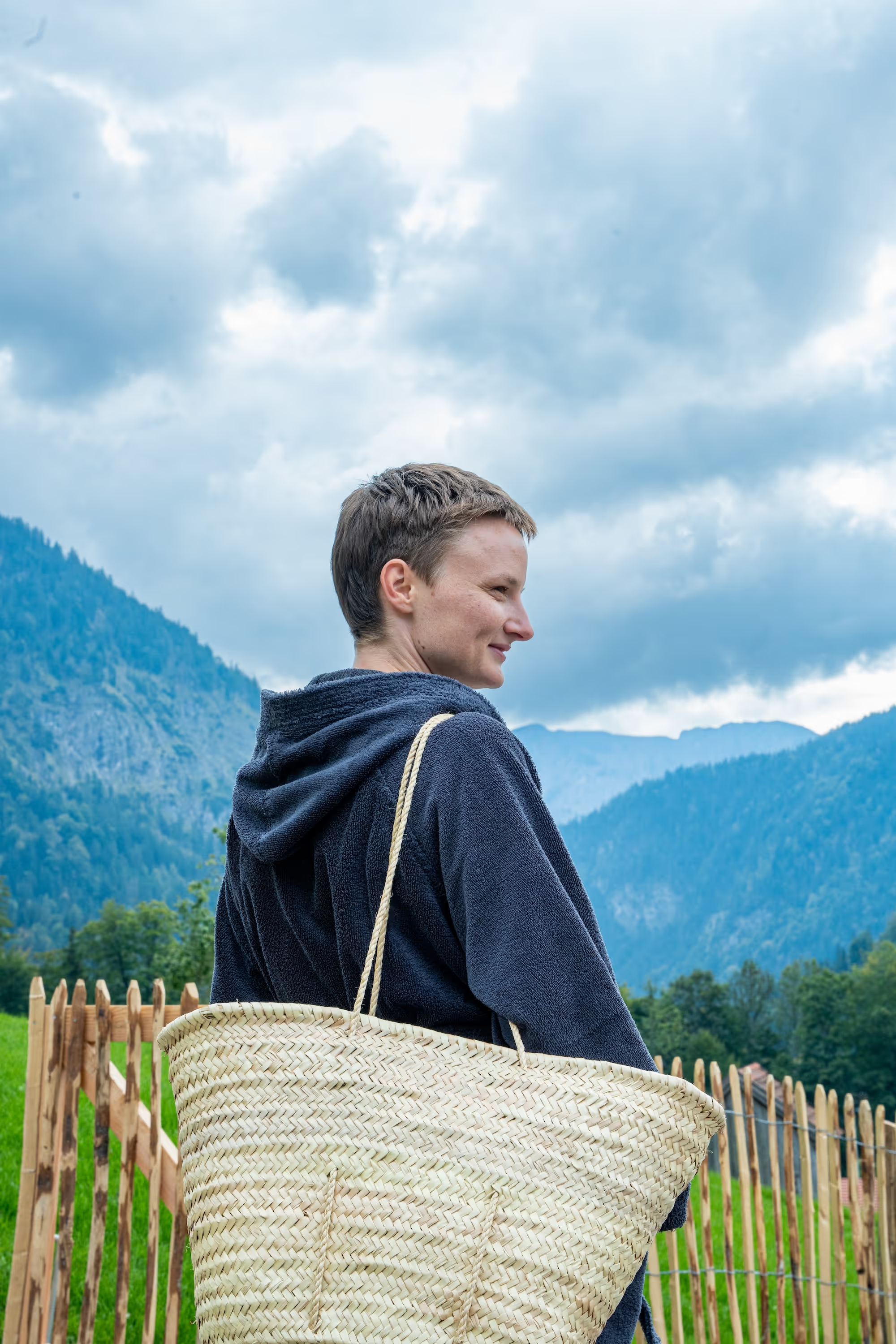
When the screen loses its rhythm, another one takes over. In the mountains, it comes from the landscape. The morning doesn't begin with a glance at a display, but with the light over the valley. Bayrischzell is located in Upper Bavaria, southeast of Munich, in the upper Leitzach valley; from the Tannerhof, the view opens up over alpine meadows and fruit trees toward the Wendelstein. The mountains stand all around, with forests and weather behind them—a backdrop that doesn't try to impress, but simply sustains.
This setting creates a day that structures itself. A walk across the alpine meadow, along the mountain stream, up to the next ridge, or back again. The guided hikes and Nordic walking sessions offered as part of the Tannerhof day fit in naturally without over-scheduling your time. Those who prefer to stay indoors will find yoga, Pilates, Feldenkrais, or sound baths in our weekly program—activities that focus your attention rather than scattering it. Here, too, participation is optional, never mandatory. The rhythm follows the guest, not the other way around.
This creates something many don't expect when they first arrive—not boredom, but depth. A day without constant interruptions has more hours than you would have thought possible. It is precisely in these hours that you can find rest and the inner silence that otherwise remains hidden beneath the constant noise.
Warmth, water, and the view outside
At the Tannerhof, retreating also involves the element of water and the warmth of the sauna. The 2025 BadeHarpfe combines a Finnish sauna, a panoramic relaxation room, and an endurance and strength fitness area with an outdoor natural pool. The pool is 25 by 5 meters, naturally filtered, heated from April to October, and used for ice bathing in winter; it overlooks the view between the Wendelstein and the Sonnwendjoch. A swim with a mountain backdrop, with no screen in sight—sweat, laugh, dive.
The BadeHarpfe adopts an old timber construction principle from the Alpine region and translates it into new alpine architecture: lots of wood, lots of light, and a view that is always directed outward. Those who sit here aren't looking at a device, but at the mountains. This is the quiet logic of the house: where the view is free to look outside, the screen is not missed. If you would like to learn about the range of treatments and therapies that accompany this framework—from massages and wraps to breathwork—you can find them in our treatment offerings.
When you need more than just a retreat
For some, a quiet break is enough. For others, the retreat becomes an opportunity to take a closer look at what is fueling their exhaustion. The Tannerhof supports both. Those dealing with exhaustion, persistent stress, or a desire for mental resilience will find a framework in our Mental Resilience program, which includes an initial medical consultation, psychotherapeutic coaching, movement and creative activities, and the retreat spaces of the house.
The editorial background is sober: exhaustion occurs when the brain remains in a stress-hormone frequency for too long. What helps is repeated, complete shutdown—not just sleep and weekends. A place where connectivity is turned down, the day follows a mountain rhythm, and medical support is available creates a framework for this. This is not a diagnosis or a promise of therapy; the treatment of exhaustion belongs in medical hands, whether at the Tannerhof or at home. If you would like to plan or book your own retreat, you can get started via our Relaxation and Enjoyment hub.
FAQs
This refers to a property that incorporates a conscious retreat from screens and constant connectivity into your stay. At the Naturhotel Tannerhof in Bayrischzell, Wi-Fi is only available in the main buildings, there are no TVs in the rooms, and phones stay in your pocket at the dining table. Analog spaces and the rhythm of the mountains provide a structure for switching off, without making it a requirement.
Yes, in the main buildings. In the Lufthütten and hut towers, connectivity is intentionally kept low-key; if you need access there, you can reserve a hotspot upon request. This allows you to decide for yourself whether your hillside hut remains a retreat or becomes a workspace.
The room does not come with a TV as standard – we prefer to offer an unobstructed view of the outdoors. However, a television can be provided upon request. This way, the choice of whether to include a screen in your stay is entirely up to you.
There is plenty to fill your day the analog way: the reading room with newspapers and books, the fireplace lounge with vinyl records and board games, the sun deck above the cabins, and the rock pool in the forest. You can also enjoy hikes, our weekly program featuring yoga, Pilates, Feldenkrais, or sound baths, and the outdoor natural pool at the BadeHarpfe.
The Tannerhof describes its own philosophy, not a medical promise. Studies on nature and attention suggest that natural environments help restore directed attention, and research on evening light shows that less screen time in the evening can ease the sleep-wake cycle. For persistent exhaustion, the Mental Resilience program provides medical support.
Yes. The Tannerhof nature hotel is located in Bayrischzell in the Upper Bavarian Leitzach Valley, nestled between alpine meadows, a mountain stream, and views of the Wendelstein. My mountain hideaway describes this retreat, where consciously disconnecting from screens and constant availability is part of the experience.
Sources
- Kaplan S.: The restorative benefits of nature: Toward an integrative framework, Journal of Environmental Psychology, 1995. Overview of Attention Restoration Theory: Attention restoration theory.
- Harvard Health Publishing, Harvard Medical School: Blue light has a dark side, 2024.
- Hunter MR, Gillespie BW, Chen SY: Urban Nature Experiences Reduce Stress in the Context of Daily Life Based on Salivary Biomarkers, Frontiers in Psychology, 2019.
- Internal source: Naturhotel Tannerhof, Relaxation and Enjoyment and Mental Resilience.
Health programs at Tannerhof

Body Detox Fasting

Mental Resilience
Longevity

Immune Booster

Aesthetics

Nutrition
"I feel a lightness I have missed for a long time"
ELLE Magazine