A Fasting Week Day by Day: The Tannerhof Course
From the relief day through the intake consultation and the transition days to breaking the fast and the rebuilding phase — how a Buchinger fasting week unfolds step by step at Tannerhof.

A Buchinger fasting week unfolds in clear phases: relief day, medical intake consultation and fasting start on the first fasting day, transition days, several fasting days, breaking the fast, and rebuilding days over roughly one third of the fasting time. At Naturhotel Tannerhof this path has been medically guided for over 70 years.
The essentials
- The fasting week begins before arrival with relief at home and does not end on the last fasting day but with rebuilding back to solid food and stimulants.
- The length of stay is booked before arrival; the medical intake consultation follows on the first fasting day and shapes the concrete course together with you.
- The transition days at the start are the most demanding; afterwards a quiet, carrying rhythm often sets in.
- The breaking of the fast still counts as fasting time and begins at Tannerhof with the apple — raw or steamed, chewed very consciously.
- For first-time fasters, a good week is a fine size: about seven fasting days plus two to three rebuilding days.
The fasting week at a glance
A fasting week is not a single act of abstention but an arc with beginning, middle and transition. Buchinger therapeutic fasting is the conscious, time-limited abstention from solid food and stimulants — not a zero-calorie diet and not a primary weight-loss method, but a therapeutic method, a cleansing on several levels, and a meeting with oneself. At Naturhotel Tannerhof, fasting belongs to the DNA of the house, introduced by Johannes von Mengershausen and medically guided across three generations of physicians.
More at Body Detox and on the Buchinger Method page.
| Day | Phase | What happens |
|---|---|---|
| Before arrival | Relief at home | One or more relief days, for example as a fruit, potato, vegetable or raw-food day. |
| Arrival day | Relief day | A light vegetable plate in the evening. |
| 1st fasting day | Intake consultation & fasting start | First the medical conversation with history-taking, examination including bioimpedance analysis and medication review. Then, if suitable, the fasting start. |
| 2nd–3rd day | Transition days | The metabolism shifts; weakness, shakiness or headache may occur. |
| Fasting days | five or more | Daily rhythm of tea, water, mild vegetable broth and freshly pressed juice. |
| Breaking the fast | still counts as fasting | Midday a small faster's broth, then the apple. |
| Rebuilding days | ~1/3 of fasting time | Gradual return to solid food and stimulants. |
Before arrival: the relief days
A fasting week does not begin with the first cup of fasting tea but already at home. The doctors at Tannerhof recommend one or more relief days before arrival. Tried variants: a fruit, potato, vegetable or raw-food day.
On the arrival day itself there is a light vegetable plate in the evening. The length of stay is already booked at this point; the concrete day plan is shaped the next day together with the medical team.
The first fasting day: intake consultation and fasting start
At the start is the intake consultation — and only after that, if suitable, the actual fasting start. The intake consultation is holistic: history-taking, physical examination including bioimpedance analysis, medication review — plus the questions that carry the fast: why you want to fast, what goals you have at Tannerhof, what fasting experience you bring.
Only then does the fasting start begin, classically with Glauber's salt — a mild salt that empties the gut at the start. It is optional; the handling is decided individually in the intake consultation.

The transition days: the body switches over
The first two to three fasting days are the most demanding. Weakness, shakiness, nausea or headache are possible. They belong to the process; the medical team accompanies this phase. The metabolic switch — from glucose to fatty acids and ketone bodies — sets in roughly 24 to 72 hours after the start (de Cabo and Mattson, NEJM, 2019).
The fasting days: a rhythm of their own
Over the day, fasting guests take in around three litres of fluid: fasting tea, water, lemon and ginger water.
- Morning: a herbal tea.
- Midday: a mild vegetable broth in the Fasterstube.
- Evening: a freshly pressed fruit or vegetable juice, optionally with buttermilk or Sojade.
If needed, further protein and an alkaline preparation are added; a spoon of honey or an espresso may bridge a low. People who fast need a different beat than someone enjoying the in-house 3/4-Pension.
We recommend five fasting days and upward; the longer one fasts, the deeper the effects. The PLOS One study by Wilhelmi de Toledo and colleagues (2019) documented in 1,422 fasters across four to twenty-one days an increase in well-being with very good safety.
Movement and treatments during the fasting days
Movement stays part of fasting, only at a different pace. Recommended: moderate aerobic and moderate strength training, plus yoga, Feldenkrais, Tai Chi, Theraband training or a walk. Summit tours and running are possible, only slower — the body nourishes itself from within.
Accompanying treatments: medical follow-up, IHHT altitude training depending on the programme, Kneipp alternating affusion, hay flower and aromatic wraps, mud and warm packs, magnesium-rich detoxifying baths, fasting massage, detoxifying massage with king's oil or acidosis massage, lymphatic drainage, foot reflexology, breathing therapy and sauna. For the mental side: psychotherapeutic coaching, nature coaching and art therapy.
Breaking the fast: the holy apple
Breaking the fast still counts as fasting time. At midday it begins with a small cup of faster's broth. Then follows the holy apple, raw or steamed, each bite chewed thirty to forty times. This very conscious chewing gently prepares digestion for what it has not done for days.
In the evening of breaking the fast there is a vegetable soup — this time with vegetable pieces. So the body makes the first step back to solid food.

The rebuilding days: back into everyday life
Rebuilding extends over roughly one third of the fasting time. At the centre: what is good for the microbiome — easily digestible vegetables, fermented foods, fibre.
- Breakfast: yogurt with linseed and soaked prunes.
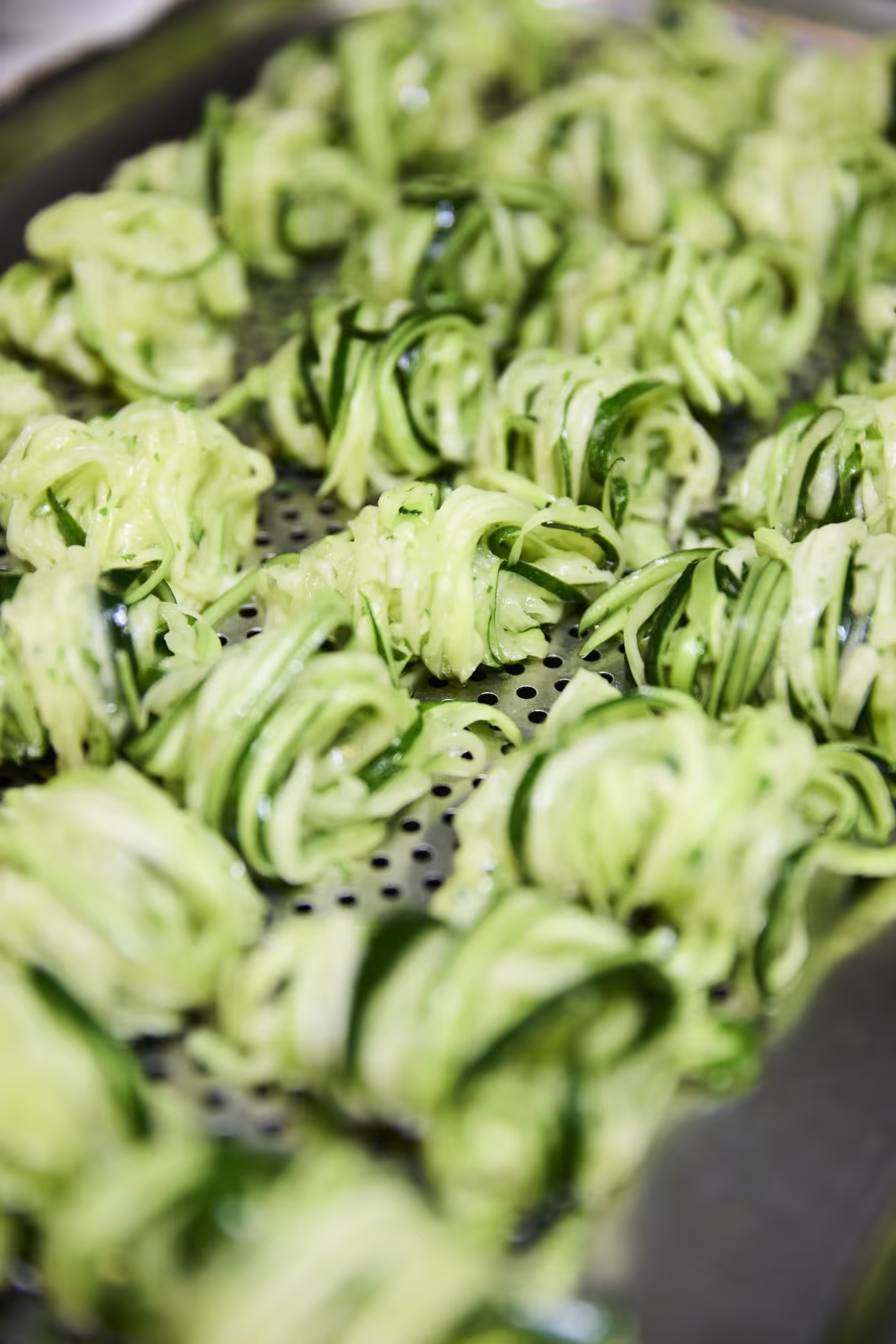
- Midday: light vegetables, salads, a vegetable soufflé or stuffed zucchini, later also fish.
- Evening: the small Schlanke Tanne vegetable plate with rotating protein.
At the end is the closing medical consultation. If a sustainable change is wanted, Schlanke Tanne Low Carb can follow.
Discovering therapeutic fasting at Tannerhof
More at Body Detox and on the methodology at Buchinger therapeutic fasting.
FAQs
A fasting week begins with relief days at home and a light vegetable plate on arrival evening. On the first fasting day come the medical intake consultation and the fasting start, then the transition days, several fasting days in the tea-broth-juice rhythm, breaking the fast with the apple, and finally rebuilding days over roughly one third of the fasting time.
The intake consultation takes place on the first fasting day after arrival, not on arrival day itself. It covers history-taking, physical examination including bioimpedance analysis and medication review, plus questions about goals, life situation and previous fasting experience. The fasting start follows the consultation.
Glauber's salt is a mild salt that empties the gut at the start of fasting and eases the start. It is the classical tool, but optional: depending on tolerance, other approaches are considered. The handling is always discussed individually in the medical intake consultation, which precedes the fasting start.
We recommend five fasting days and upward. For first-time fasters, a good week is a fine size — about seven fasting days plus two to three rebuilding days. The length is booked before arrival and can be adjusted, typically extended, with the medical team from the intake consultation onward.
On the first two to three fasting days, metabolism shifts from glucose to fatty acids and ketone bodies — the metabolic switch sets in roughly 24 to 72 hours after fasting onset. Weakness, shakiness or headache can occur in this phase; they belong to the process, usually pass on their own and are accompanied by the medical team.
The fasting week ends with breaking the fast and the rebuilding days. Breaking the fast begins with the apple, raw or steamed, eaten with conscious chewing. Over roughly one third of the fasting time, solid food and stimulants return step by step. In the medical closing consultation, the team discusses everyday eating afterward.
Sources
- ÄGHE: Guidelines on Fasting Therapy.
- de Cabo R., Mattson M. P.: Effects of Intermittent Fasting on Health, Aging, and Disease, NEJM, 2019.
- Wilhelmi de Toledo F. et al.: Safety, health improvement and well-being during a 4 to 21-day fasting period, PLOS One, 2019.
- In-house source: Naturhotel Tannerhof, The Buchinger Method and Body Detox.
Note
This article describes the approach and practice of Naturhotel Tannerhof regarding the course of a Buchinger fasting week. It does not replace individual medical advice. A telephone medical pre-consultation is available on request.
Health programs at Tannerhof

Body Detox Fasting

Mental Resilience

Longevity

Immune Booster

Aesthetics
Nutrition
"I feel a lightness I have missed for a long time"
ELLE Magazine