Intermittent Fasting in Everyday Life: Keeping the Effects of Therapeutic Fasting
How 16/8 intermittent fasting carries the benefits of a fasting week into everyday life – and the role the Schlanke Tanne Intervall plays at Naturhotel Tannerhof.

16/8 intermittent fasting means going without solid food for around sixteen hours a day and eating within an eight-hour window. It does not replace multi-day therapeutic fasting after Buchinger; it carries its effect into everyday life. That way, much of what a fasting week sets in motion stays with you afterwards.
The essentials at a glance
- 16/8 intermittent fasting is an everyday integration of the benefits of compact fasting, not a replacement for multi-day therapeutic fasting after Buchinger.
- The daily eating break sets off a metabolic switch from glucose to fatty acids and ketone bodies, as de Cabo and Mattson described in 2019 in the New England Journal of Medicine.
- Therapeutic fasting after Buchinger is compact fasting over several days; intermittent fasting is the daily rhythm that follows – both work towards cleansing and renewal.
- At Naturhotel Tannerhof, the Schlanke Tanne Intervall is an in-house diet that combines 16/8 with low carb: two meals a day, plenty of vegetables, high-quality protein.
- Which follow-on nutrition fits is discussed at Tannerhof in the closing medical consultation – individually, not by formula.
Why the effects of fasting can fade in everyday life
A fasting week is a turning point. The body switches to burning fat, cellular recycling gets going, sleep often grows lighter, the mind quieter. And then everyday life returns: the quick meals in between, the late dinner, reaching for bread because it is simply there. Much of what was reordered during the fasting week can shift back within a few weeks.
This is exactly where intermittent fasting comes in. It is not the big fast over several days but a quiet daily rhythm that regularly sends the body into an eating break. Anyone who wants to know, after a fasting week, what the transition into everyday life can look like will find the in-house diet and the method on the Tannerhof hub on therapeutic fasting and the Schlanke Tanne low carb. It also describes how multi-day fasting and the nutrition that follows belong together.
The idea behind it is simple: a fasting week opens something you do not have to lose again within a week. Intermittent fasting is the way to keep that opening open over the weeks and months that follow.
What 16/8 intermittent fasting means
Intermittent fasting – also called time-restricted eating – divides the day into two phases: an eating phase and a fasting phase. In the common 16/8 rhythm, around sixteen hours without solid food sit alongside an eating window of about eight hours. In practice this often means no breakfast, a first meal at midday, a second in the early evening, and in between and afterwards only water, tea or coffee without any meaningful energy.
Unlike multi-day therapeutic fasting, this is not an exceptional state but a beat that fits into a normal day. You work, move, live – and simply place your meals within a particular time window. That is the appeal: it needs no time out, no special setting, no pause over several days. It needs only a rhythm you hold.
The framing matters. Intermittent fasting is not a substitute for Buchinger. Therapeutic fasting after Buchinger is compact fasting over several days, the deliberate, time-limited abstention from solid food and stimulants, carried by tea, water, mild soup and freshly pressed juices. Intermittent fasting, by contrast, is the recommended way to carry the benefits of that compact fast into everyday life. The two do not compete; they complement each other.
What happens in the body: the metabolic switch
Behind intermittent fasting lies a well-studied mechanism. Rafael de Cabo and Mark Mattson described it in 2019 in the New England Journal of Medicine as “metabolic switching”: when the eating break is long enough, the readily available glucose stores in the liver fall, and the metabolism starts to draw energy from fatty acids and the ketone bodies formed from them. This switch is the same one that carries multi-day fasting – only on a small scale, fresh each day.
In their review, de Cabo and Mattson gather evidence that this regular switch goes hand in hand with improved cellular stress resistance and favourable effects on metabolism, blood pressure and inflammatory markers. A randomised study from 2022, published in Nature Communications, examined 16/8 in healthy adults without obesity over several weeks and observed a changed body composition with good tolerability – a sign that the rhythm works not only with pronounced complaints but also in ordinary everyday life.
This matches what multi-day fasting sets in motion. There, too, the body works on two levels at once: it switches to burning fat, and it begins autophagy, the cellular recycling for whose discovery Yoshinori Ohsumi received the 2016 Nobel Prize in Medicine. Intermittent fasting keeps this metabolic beat alive on a small scale. Whether and in what form it fits in an individual case belongs, at Tannerhof, in the medical assessment – the house makes no blanket promises of cause and effect.

A 16/8 daily rhythm to take with you
An intermittent fasting day needs no complicated planning. It follows a clear picture: a long break through the night and the morning, then two good meals. The overview below shows a typical 16/8 rhythm as the Schlanke Tanne Intervall sets it out at Tannerhof – as a guide, not a rule.
| Time of day | What | Fasting or eating |
|---|---|---|
| Morning | Tea or coffee with a small dash of milk, plus water, lemon water or hot ginger water. No breakfast. | Fasting phase |
| Late morning | Around one to one and a half litres of fluid through the morning, still without solid food. | Fasting phase |
| Midday | First and main meal: hot vegetable broth, salad with a small protein addition, a main course with vegetables and fish, meat, egg, cheese or tofu. | Eating window |
| Afternoon | A small snack is possible, such as a handful of almonds. | Eating window |
| Evening | Second meal: vegetable soup, then a plate of vegetables or salad with a varying protein addition. | Eating window |
| Night | A long eating break until the next midday. | Fasting phase |
Two things carry this rhythm. First, the window itself: the long break through the night and morning reliably sends the metabolism into burning fat. Second, the quality of the meals. If the eating window is filled with bread, sweets and starchy sides, part of the effect is lost. That is why Tannerhof combines the interval with low carb.
The Schlanke Tanne Intervall: 16/8 and low carb at Tannerhof
At Naturhotel Tannerhof there is an in-house diet for exactly this everyday transition: the Schlanke Tanne Intervall. The Schlanke Tanne is the house low-carb diet – low in carbohydrates, rich in vital nutrients, with high-quality protein, plenty of vegetables, fibre and good fats. The Intervall variant combines this low-carb base with the 16/8 rhythm: two meals a day after a sixteen-hour break from food.
In concrete terms: no breakfast in the morning, only tea or coffee with a small dash of milk, and plenty of water, lemon or ginger water through the late morning. At midday the main meal as in the Schlanke Tanne Drei – vegetable broth, salad, a warm main course with protein and vegetables, without a starchy side. In the evening, vegetable soup and a plate of vegetables or salad with a varying protein addition. Bread, starchy sides, fruit and pure fruit juices stay out at this stage, as does alcohol.
The effect lies in the interplay. The 16/8 window provides the daily eating break, the low-carb orientation keeps blood sugar calm and makes burning fat easier. The Schlanke Tanne Intervall can be followed in one stretch over several weeks and works well as a bridge after a fasting week. Anyone who wants to look at the diet and the packages in detail will find them on the page for the Schlanke Tanne low carb and interval. How the table feels at the house – fresh, regional, one menu a day – is shown by a look at the cuisine at Tannerhof.
From compact fasting into everyday life: a calm transition
The finest effect of a fasting week is not the single number on the scales but the new relationship with food. After breaking the fast and the build-up over roughly a third of the fasting period, the body is receptive to a different rhythm. This is exactly the moment to reorder everyday life rather than fall back into old patterns.
At Tannerhof, this transition is part of the fast. In the closing medical consultation, the accompanying doctors review what has changed and discuss which follow-on nutrition fits in everyday life. For many that is the Schlanke Tanne – in the Drei variant with three meals or as Intervall with the 16/8 rhythm. Which form carries better depends on the individual, on their day, their preferences, their goals. There is no general formula for it.
Anyone who wants to walk the whole arc once for themselves – from the fasting week into the everyday life that follows – will find the framework and online booking in the Body Detox programme, the Buchinger therapeutic fasting at Tannerhof. Intermittent fasting is then not a big new project but the quiet continuation of what began in the fasting week.
What intermittent fasting can do – and what it cannot
Intermittent fasting keeps alive a metabolic beat related to multi-day fasting. It is suited to everyday life, needs little effort and can be held for months. The Ärztegesellschaft Heilfasten und Ernährung (ÄGHE) also lists intermittent fasting in a 16/8 rhythm as a workable way to extend therapeutic fasting into everyday life. The guidelines on fasting therapy come from the ÄGHE; further studies on fasting therapy can be found there.
At the same time, intermittent fasting is no replacement for the depth of a fasting week. Multi-day therapeutic fasting after Buchinger goes further: it brings the turning point, the abundance of time with oneself, the medical guidance and the deeper cleansing and recycling processes that only really get going over several days. Intermittent fasting carries this experience into everyday life without copying it.
So a meaningful interplay emerges:
- Therapeutic fasting after Buchinger is the compact fast over several days – the great turning point, medically guided.
- 16/8 intermittent fasting is the daily rhythm that follows – the everyday integration of the benefits of fasting.
- The Schlanke Tanne Intervall is the house way to combine the two: 16/8 with low-carb quality.
Anyone who takes on this arc turns one week a year into not an island but a beginning. Perhaps that is exactly the old Tannerhof line in present-day form: Mensch, werde wesentlich.
Discover therapeutic and intermittent fasting at Tannerhof
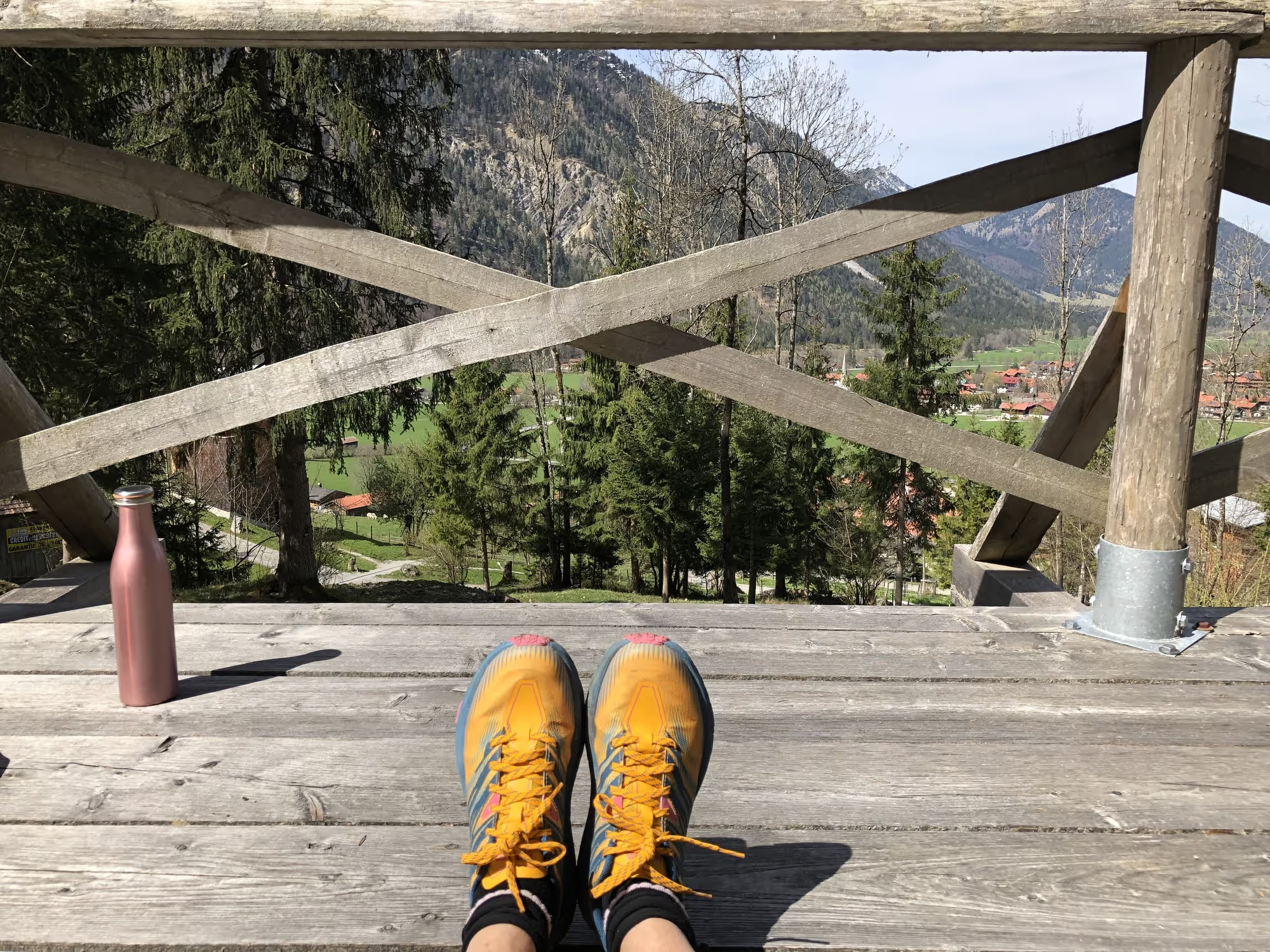
Naturhotel Tannerhof has guided Buchinger therapeutic fasting medically for more than 70 years and thinks the transition into everyday life through from the start. With the Schlanke Tanne Intervall there is an in-house diet that combines 16/8 and low carb – set in Bayrischzell, between alpine meadow, mountain stream and the view towards the Wendelstein, my hideaway in the mountains. Anyone who wants to see the framework and book online will find it in the Body Detox programme and on the hub on therapeutic fasting and the Schlanke Tanne low carb.
FAQs
16/8 intermittent fasting divides the day into a fasting and an eating phase: around sixteen hours without solid food, an eating window of about eight hours. In practice this often means no breakfast, a first meal at midday and a second in the early evening. During the fasting phase, water, tea and coffee without any meaningful energy are allowed.
No. Therapeutic fasting after Buchinger is compact fasting over several days, the deliberate, time-limited abstention from solid food and stimulants, medically guided. Intermittent fasting is not a replacement but the recommended way to carry the benefits of compact fasting into everyday life. The two complement each other rather than compete.
The daily eating break sets off a metabolic switch from glucose to fatty acids and ketone bodies, which de Cabo and Mattson described in 2019 in the New England Journal of Medicine as “metabolic switching”. This switch is related to that of multi-day fasting and stays regularly active in everyday life through the 16/8 rhythm.
The Schlanke Tanne Intervall is a variant of the in-house low-carb diet at Naturhotel Tannerhof. It combines the 16/8 rhythm with low carb: two meals a day after a sixteen-hour break from food, with plenty of vegetables, high-quality protein and good fats. Bread, starchy sides, fruit, pure fruit juices and alcohol stay out at this stage.
After breaking the fast and the build-up, the body is receptive to a new rhythm. That is exactly when intermittent fasting works well as a bridge into everyday life. At Tannerhof, the closing medical consultation discusses which follow-on nutrition fits – the Schlanke Tanne Drei or the Schlanke Tanne Intervall.
Intermittent fasting is suited to everyday life and well tolerated, but it does not replace an individual medical assessment. In pregnancy, while breastfeeding, with an eating disorder, chronic illness or ongoing medication, the question belongs in a medical consultation. At Tannerhof, the right form of nutrition is discussed together with the medical team.
Sources
- de Cabo R., Mattson M.P.: Effects of Intermittent Fasting on Health, Aging, and Disease, New England Journal of Medicine 381:2541–2551, 2019.
- Ärztegesellschaft Heilfasten und Ernährung e. V. (ÄGHE): Guidelines on fasting therapy (consensus 2002, update 2013).
- Jamshed H. et al.: Effectiveness of early time-restricted eating – randomized controlled trial in healthy volunteers without obesity, Nature Communications, 2022.
- The Nobel Prize in Physiology or Medicine 2016, Yoshinori Ohsumi: for his discoveries of mechanisms for autophagy.
- In-house sources: Naturhotel Tannerhof, therapeutic fasting and the Schlanke Tanne low carb and Body Detox.
Health programs at Tannerhof

Body Detox Fasting

Mental Resilience

Longevity

Immune Booster

Aesthetics
Nutrition
"I feel a lightness I have missed for a long time"
ELLE Magazine