Mental Resilience: Reduce Stress for Good and Build Resilience
How mental resilience grows and stress does not just briefly ease but lastingly quietens – a calm overview from Naturhotel Tannerhof in Bayrischzell.

Mental resilience is the ability to adapt to strain and return to balance after stress. It grows from relationships, self-care, clear thinking and meaning. Naturhotel Tannerhof strengthens it through a calm rhythm, medical guidance, movement, coaching and the nature around Bayrischzell.
Key points at a glance
- Mental resilience is not an inborn talent but a skill that strengthens over time and with practice – much like a muscle.
- Reducing stress for good means more than a single weekend: it takes repeated, complete winding down that holds up in everyday life.
- At the Tannerhof, the Mental Resilience programme runs on the 3/4-rhythm and combines a medical intake consultation, coaching, movement and retreat.
- Movement such as yoga, Feldenkrais, Tai Chi and breathing therapy works on body and mind at once and is part of the daily weekly programme.
- This article describes the preventive building of resilience – not recovery after a state of acute exhaustion.
What mental resilience means
Mental resilience is the ability to adapt to difficult experiences and return to balance after strain. The American Psychological Association describes it as the process of adapting well in the face of adversity, strain or ongoing stress. It is more than bouncing back: difficult phases can also bring growth. What matters is that resilience is not a character trait you either have or lack, but a skill that strengthens over time and with practice – much like a muscle.
It is worth drawing a line here. This article is about the preventive, general building of mental resilience and the lasting reduction of stress – not about recovery after a state of acute exhaustion. Anyone asking what a time-out after deep exhaustion looks like will find a separate path for that. Here the point is not to reach that stage at all: to strengthen how you handle pressure before it becomes overwhelming. If you want to look at the concrete framework at the house and book it, you will find it in the Mental Resilience programme.
At Naturhotel Tannerhof this resilience grows not from a single programme but from an interplay: from a calm rhythm, from medical guidance, from daily movement and relaxation practice, and from the deliberate retreat the house offers its guests. My hideaway in the mountains is more than an image for this. It is the setting in which pressure dissolves and what matters regains room.
Why stress takes hold – and how it eases for good
Stress is, at first, a sensible response. The body releases stress hormones, ramps up, becomes capable. It turns problematic when this ramping-up no longer stops – when the brain stays too long in a stress-hormone frequency and the full winding down never comes. Sleep and a free weekend are then often not enough. Lasting stress reduction needs the repeated, complete coming-down, not just the short pause between two appointments.
This is exactly where the Tannerhof rhythm comes in. The 3/4-rhythm – the base board on the relaxation side of the house, with breakfast, a light lunch of salad and soup, and a multi-course dinner – gives the day a calm order. The meals provide structure without overwhelming. Between them lies time: for movement, for a treatment, for a walk on the slope, for nothing at all. This rhythm is not decoration but method. It takes out the pace that keeps stress running in everyday life.
Research on nature shows that a changed environment has a measurable effect. A systematic review by Antonelli and colleagues from 2019 evaluated studies on the Japanese practice of shinrin-yoku, the deliberate stay in the forest, and found that cortisol levels – a marker of stress – were lower in the forest groups than in the urban comparison groups. Bayrischzell, the Leitzach valley and the view to the Wendelstein are not wellness décor but part of the effect.
Four Pillars of resilience
Anyone wanting to build resilience does not start from nothing. The American Psychological Association assigns the main starting points to four areas, and they are easy to find again at the Tannerhof:
- Connection. Good relationships carry you through hard phases. At the Tannerhof they form unobtrusively – at the curated shared tables, in open group movement sessions that make it easy for solo travellers to join in.
- Wellbeing. Physical practice strengthens the mind. Movement, sleep, time spent moving in nature and a calm diet belong together.
- Clear thinking. Strain becomes lighter when perspectives fall into order. That is exactly what coaching and creative work make room for.
- Meaning. Something that points beyond the moment gives footing. The stillness of the mountains helps you find an ear for it again.
These four pillars are not a checklist to work through. They describe what resilience grows from – and they make it clear why the Tannerhof does not rely on a single treatment but on an interplay of rhythm, movement, encounter and guidance.

Movement that works on the mind
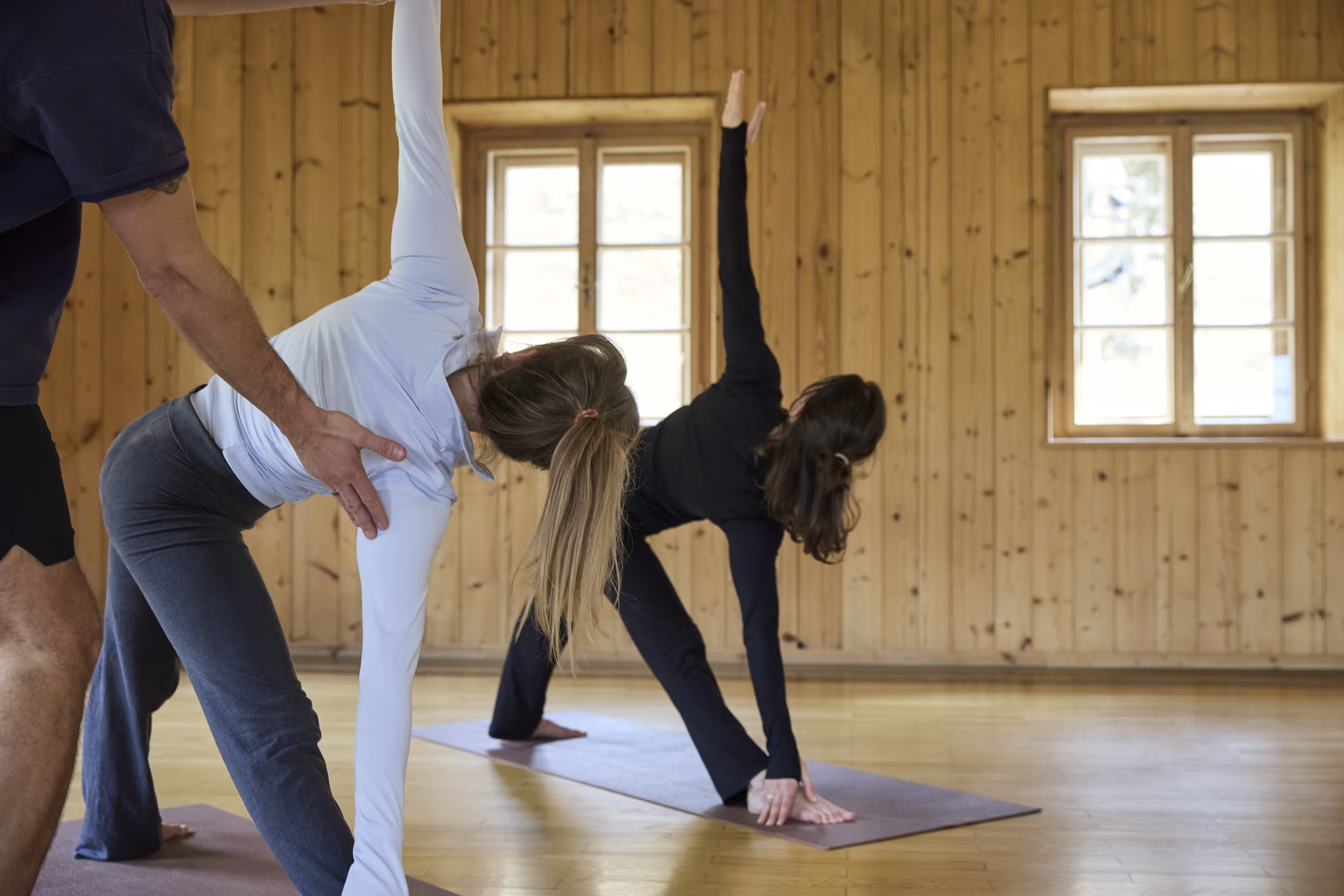
Movement is one of the most reliable ways to reduce stress and strengthen resilience. At the Tannerhof it belongs to the Tannerhof Day, the daily weekly programme with at least three moving, relaxing or informing offerings on six days a week. Participation is included, registration on the posted lists. Whoever wants to is in; whoever needs quiet leaves it.
The range is deliberately broad, because different people need different ways in:
- Yoga with Barbara Wittmann – breath, posture and attention come together.
- Feldenkrais – subtle movement sequences that stimulate the nervous system and open up new patterns of movement.
- Tai Chi with Gottfried Köhl – slow, flowing movement that clears the head.
- Breathing therapy – the breath is the most direct access to the autonomic nervous system and a reliable way to calm the ramping-up.
- Pilates, aqua gymnastics, Nordic walking and guided hikes into the surrounding area – for everyone who finds their way into calm through the body.
In winter, ice bathing in the outdoor natural pool is added, a strong stimulus that wakes the circulation. And there is the sound bath with singing bowls in the historic sauna. That movement and mindfulness practice work on the mind is well studied: a much-noted review by Goyal and colleagues, published in 2014 in JAMA Internal Medicine, evaluated 47 controlled trials with around 3,300 participants and found small to moderate improvements in anxiety, low mood and stress for mindfulness-based programmes. Practice works – not overnight, but reliably.
Coaching: room for the mind
Sometimes you need someone who listens and asks questions. The coaching offered at the Tannerhof opens that room, always voluntary and always individual. The distinction matters: the coaches accompany the mind, they do not replace medical or psychotherapeutic treatment – with one exception that their qualification includes.
- Holistic, psychotherapeutic coaching with Trixi Wolfseher, qualified psychologist, positive-psychology consultant and systemic psychotherapist in training.
- Nature coaching Go 4 U with Birgit Holzwarth, alternative practitioner and mental trainer – the process takes place outdoors, in movement, out of entrenched patterns of thought.
- Business and communication coaching Sich Ausrichten with Petra Simone Reindl, business graduate with many years of leadership experience – for professional poise, negotiating skill and quick-wittedness.
- Art therapy with Nele von Mengershausen, artist and art therapist – she mobilises through work with image and colour; prior artistic experience is not needed.
What connects these offerings is their aim: not the quick antidote but the slow strengthening of your own means. Whoever has experienced it once takes it home. That is exactly the difference between short-term relief and lasting resilience.
The Mental Resilience programme at the Tannerhof
The Mental Resilience programme bundles these building blocks. It runs on the 3/4-rhythm and is aimed at people who want to strengthen their resilience, guard against ongoing stress and forestall a looming imbalance. At the start there is a medical intake consultation that clarifies the individual starting point. From it follows what comes together during the stay: coaching sessions, individual and group movement offerings from the weekly programme, creative and artistic work, and the retreat spaces of the house.
Diagnostics and medical treatments can be booked in addition. The therapy offering at the Tannerhof is deliberately broad: from bioimpedance analysis for measuring body composition and IHHT altitude training, through wraps and compresses such as hay-flower and aroma wraps, baths and pourings such as the Kneipp alternating pour, to massages, lymphatic drainage and craniosacral therapy, which harmonises the autonomic nervous system. No one makes the selection for you in advance – it grows from the conversation with the medical team. The treatments overview gives a sense of what is available.
Setting and guidance carry equal weight here. The stay in a moving landscape carries the process, and the medical and coaching guidance gives it direction. If you want to learn more about the relaxation side of the house, you will find it under Relaxation and pleasure.
Retreat as the framework
Some of resilience comes not from an offering but from its opposite: from leaving things out. The Tannerhof is built as a retreat. In the Kammerln, the deliberately pared-back rooms of the Neue Tann, there is no television. The Wi-Fi is intentionally mediocre, and in the air huts and hut towers there is deliberately none. In the dining room mobile devices stay in your pocket. This is not strictness but an invitation to set aside constant reachability for a while.
This reduction creates what everyday life rarely allows: undivided time. The sun deck above the huts with its forest terrace and the rustle of wind, the yoga mats in the cupboard, the fireplace room with jukebox and board games, the reading room in the Alte Tann, the rock pool in the woods on the slope – all of these are places where you come to rest. Here coming to rest becomes not a phrase but a state you learn to feel again. And from this very feeling grows, over the days, the inner stillness that does not just briefly interrupt the stress but makes it quieter. Become essential – the old Tannerhof thought means nothing else.
Taking resilience home
The real thing shows after departure. A stay is a turning point, but resilience keeps growing where everyday life begins again. Much of it carries over: a breathing pattern that helps under stress. A yoga sequence for the morning. The experience that a walk in the green really does change something. The resolve to put the phone away in the evening. Resilience is, in the American Psychological Association's image, like a muscle: it needs time and intention, and it grows with practice.
So a week in the hideaway becomes more than a pause. It gains a beginning, a middle and a transition into everyday life in which what was learned holds. If you want to take this path, you will find the framework in the Mental Resilience programme and an overview of what the house offers under Relaxation and pleasure.
Discover Mental Resilience at the Tannerhof
Naturhotel Tannerhof strengthens mental resilience through a calm rhythm, medical guidance, daily movement, coaching and the nature around Bayrischzell, between alpine meadow, mountain stream and the view to the Wendelstein. If you want to look at the concrete framework and book it, you will find it in the Mental Resilience programme, an overview of the treatments in the treatments offering, and the relaxation side of the house under Relaxation and pleasure.
FAQs
Mental resilience is the ability to adapt to strain and stress and return to balance after difficult phases. The American Psychological Association describes it as a process that means not only bouncing back but can also enable personal growth. Resilience is not a fixed character trait but a skill that strengthens over time and with practice.
The American Psychological Association names four starting points: supportive relationships, physical and mental wellbeing, clear and balanced thinking, and meaning and goals. At Naturhotel Tannerhof these pillars are found again in the interplay of shared tables, daily movement and relaxation practice, coaching and the calm of the mountains. Resilience grows with practice, not overnight.
Lasting stress reduction takes more than a free weekend. What matters is the repeated, complete winding down that keeps the brain from staying permanently in a stress-hormone frequency. A calm rhythm, movement, time in nature and room for the mind work together. Studies on time spent in the forest show measurably lower cortisol levels than in an urban setting.
The Mental Resilience programme runs on the 3/4-rhythm and is aimed at people who want to strengthen their resilience and guard against ongoing stress. It begins with a medical intake consultation and combines coaching sessions, movement offerings from the weekly programme, creative work and the retreat spaces of the house. Diagnostics and medical treatments can be booked in addition.
Building mental resilience is preventive and general in focus: it strengthens how you handle pressure before it becomes overwhelming. A time-out after deep exhaustion has a different emphasis, recovery after an acute state. This article describes the preventive path of strengthening resilience in everyday life.
Yes. Movement is one of the most reliable ways to reduce stress. A review by Goyal and colleagues, published in 2014 in JAMA Internal Medicine, found small to moderate improvements in anxiety, low mood and stress for mindfulness-based programmes. At the Tannerhof, yoga, Feldenkrais, Tai Chi and breathing therapy belong to the daily weekly programme and work on body and mind at once.
No. The offerings in the weekly programme and the creative work are open to everyone. The art therapy with Nele von Mengershausen mobilises through work with image and colour; prior artistic experience is expressly not needed. The movement offerings are also designed so that beginners and the practised can take part, each at their own pace.
Sources
- American Psychological Association: Building your resilience. Definition of resilience and the four pillars connection, wellbeing, clear thinking and meaning.
- Goyal M., Singh S., Sibinga E. M. S. et al.: Meditation Programs for Psychological Stress and Well-being: A Systematic Review and Meta-analysis, JAMA Internal Medicine, 2014. 47 trials, around 3,320 participants; small to moderate improvements in anxiety, low mood and stress.
- Antonelli M., Barbieri G., Donelli D.: Effects of forest bathing (shinrin-yoku) on levels of cortisol as a stress biomarker: a systematic review and meta-analysis, International Journal of Biometeorology, 2019. Lower cortisol levels in forest groups compared with urban comparison groups.
- House sources: Naturhotel Tannerhof, Mental Resilience and Relaxation and pleasure.
Health programs at Tannerhof

Body Detox Fasting

Mental Resilience
Longevity

Immune Booster

Aesthetics

Nutrition
"I feel a lightness I have missed for a long time"
ELLE Magazine