A Retreat After Burnout: What Really Helps With Exhaustion
What a medically supervised retreat for chronic exhaustion looks like at the Naturhotel Tannerhof – mountain rhythm, psychotherapeutic coaching, nature coaching and deliberately pared-back rooms.

A retreat after burnout at the Naturhotel Tannerhof means a calm mountain rhythm, medical guidance and psychotherapeutic coaching, plus nature coaching, art therapy, movement and deliberately pared-back rooms. In the Mental Resilience programme, people recovering from chronic exhaustion find a setting in which they can truly wind down – in Bayrischzell, between alpine meadow and the Wendelstein.
The essentials at a glance
- The World Health Organization describes burn-out as a syndrome resulting from chronic workplace stress, marked by exhaustion, mental distance and reduced performance – not as a disease in its own right.
- A retreat at the Tannerhof is medically supervised: an intake consultation assesses what is needed and whether specialist or therapeutic treatment should follow.
- The Mental Resilience programme, built on the 3/4-rhythm, combines psychotherapeutic coaching, nature coaching, business coaching and art therapy with daily movement and relaxation practice.
- The rooms are deliberately pared back: no television, intentionally weak Wi-Fi, no mobile devices in the dining room – so that switching off comes more easily.
- Recovery research shows that genuinely letting go of work and time in nature measurably support wellbeing; a retreat does not replace treatment, it creates the setting for it.
What a retreat after burnout at the Tannerhof means
People looking for a retreat after a long stretch of exhaustion are rarely looking for a hotel room. They are looking for a place where the rhythm is different – slower, clearer, without constant availability. At the Naturhotel Tannerhof, such a retreat does not begin with a scheduled activity but with a different rhythm: a morning that leads across the alpine meadow rather than through the inbox, a day that breathes. My hideaway in the mountains is meant for exactly this.
A clear distinction matters. Burn-out in the narrower sense is described by the World Health Organization as a syndrome arising from chronic, unsuccessfully managed workplace stress – with exhaustion, growing mental distance from one's own work and declining effectiveness. In this classification it is not a disease in its own right. Where treatment is needed, it belongs in specialist or psychotherapeutic hands. A retreat is something separate and distinct: the setting in which recovery can take place at all. At the Tannerhof this setting is medically supervised and brought together in the Mental Resilience programme.
This article describes the retreat after acute exhaustion – the rediscovery of a sustainable rhythm. Anyone in the middle of everyday stress who wants to prevent burnout will find the other side in the companion topic on reducing stress. Here the focus is on the recovery that comes after.
Why truly winding down is so hard
Exhaustion does not build up in a single day, and it does not dissolve in one either. The core, as the check-in-instead-of-burnout perspective describes it, is simple and uncomfortable at once: the brain stays too long in a stress-hormone frequency. A weekend is then often not enough, nor is a short sleep. What it takes is a repeated, complete winding down – and time in which that winding down is not constantly interrupted again.
Recovery research describes the same phenomenon with the term psychological detachment: the inner distance from work, the act of stopping working in one's thoughts. A wide-ranging meta-analysis by Wendsche and Lohmann-Haislah, published in 2016 in Frontiers in Psychology, evaluated 86 studies with more than 38,000 employees. The finding: those who genuinely let go of work during their free time show, on average, lower exhaustion, better wellbeing and better sleep. Detachment works as a recovery mechanism – but only when it succeeds.
This is exactly where the place comes in. An environment that demands little makes letting go easier. An environment that constantly beeps and flashes keeps the stress frequency awake. At the Tannerhof, the reduction is therefore not thrift but method.
The mountain rhythm as a framework
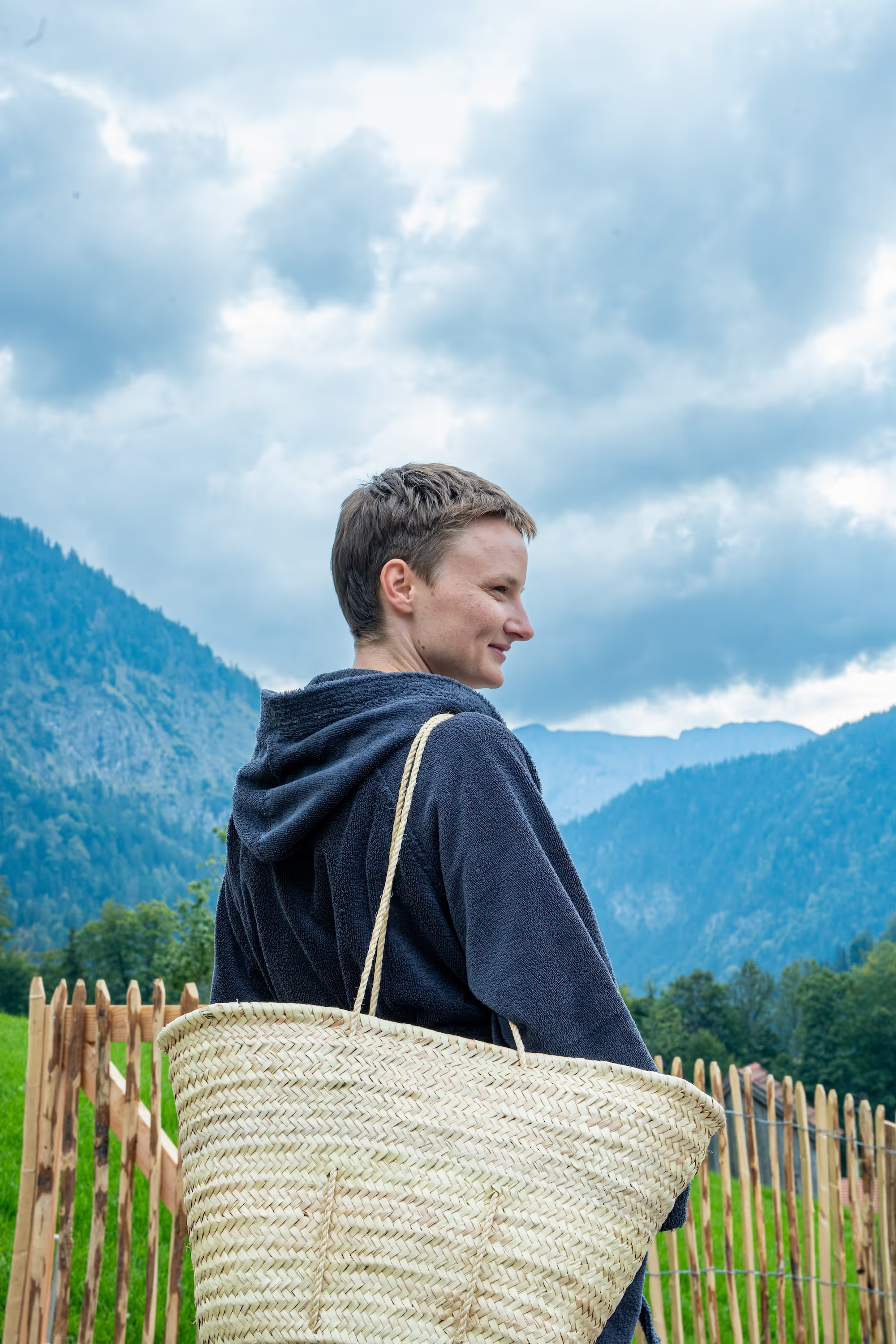
Bayrischzell lies in Upper Bavaria, south-east of Munich, in the upper Leitzach valley. From the Tannerhof the view opens across alpine meadows up to the Wendelstein. The mountains stand all around, the slender cabin towers on the slope, forest and weather behind them. It is a landscape that does not seek to impress but to hold – and that quality is more valuable in exhaustion than any spectacular effect.
That nature plays a part in the experience of stress is by now well studied. A widely cited study by Hunter and colleagues, published in 2019 also in Frontiers in Psychology, measured cortisol levels in city dwellers before and after time spent in green spaces. The result: even a stay of twenty to thirty minutes lowered the stress hormone cortisol most effectively. This is no mountain cure and no promise, but a plain, documented effect – one that is especially welcome on a retreat after exhaustion.
In the mountain rhythm this translates into a day that orders itself. A path across the meadow in the morning, a pause at midday, a treatment in the afternoon, coming to rest early in the evening. Anyone who has lived in their head for a long time notices how much an externally given rhythm, one that asks nothing of you, takes off your shoulders.
Medically supervised: what the intake consultation provides
A retreat after burnout at the Tannerhof is not a pure feel-good week but is medically supervised. It begins with a medical intake consultation. It assesses where someone currently stands, what kind of recovery makes sense and – just as importantly – whether specialist or psychotherapeutic treatment should follow. The doctors at the Tannerhof accompany the stay; they give direction and keep an eye on values and progress.
This guidance marks a clear boundary. A retreat can create space, relieve pressure, set a better rhythm in motion. An illness requiring treatment belongs in professional hands – at the Tannerhof or with one's own doctor at home. The Tannerhof promises no cure for burnout; it creates the setting in which recovery becomes possible, and it assesses what is necessary from a medical standpoint.
The medical side can be brought in as a complement where it fits. The physical examination at the house includes bioimpedance analysis to measure body composition; depending on the stay, treatments such as IHHT altitude training or, where medically appropriate, further diagnostics are added. This too belongs to the idea of a holistic retreat: body and mind are not considered separately.
Coaching and art therapy: the mental side
The core of a retreat after exhaustion at the Tannerhof is the mental support. One thing matters here: coaching and therapy are not the same. Coaching accompanies, sorts, opens up new perspectives – it does not replace psychotherapy. Where treatment is needed, it is assessed medically or therapeutically. Within this framework, a broad, professionally grounded offering is available at the house:
- Psychotherapeutic coaching with Trixi Wolfseher, qualified psychologist, positive-psychology consultant and systemic psychotherapist in training. A strengths-based approach that looks at what is sound, not only at what is fragile.
- Nature coaching Go 4 U with Birgit Holzwarth. The process takes place outdoors, in movement – out of habits, thought patterns and entrenched mental concepts.
- Business and communication coaching Sich Ausrichten with Petra Simone Reindl. This is about professional poise, negotiating skill and a clear stance – often the point at which exhaustion arises in working life.
- Art therapy with Nele von Mengershausen. Through work with images and colour, what is hard to put into words is set in motion. No prior artistic experience is needed.
These offerings can be combined or used individually, always tailored to the person who comes. A narrative impression of the psychological work at the house is given in the magazine piece Psychological coaching at the Tannerhof.
Movement, nature and daily practice
Recovery is not only sitting still. It arises just as much from movement in the right measure – and from a daily practice that gives support without demanding. On six days a week the Tannerhof offers at least three moving, relaxing or informative activities, included in the packages. That lowers the threshold especially for everyone arriving on their own.
- Movement and body: yoga, Pilates, Feldenkrais, aqua gymnastics in the indoor pool, cardiovascular training, stretching and back exercises.
- Outdoors: Nordic walking and guided hikes in the surrounding area, and in winter ice bathing in the outdoor natural pool.
- Calm and practice: tai chi, autogenic training and a sound bath with singing bowls in the historic sauna.
Added to this is bodywork with an effect on the mind from the house's own therapy catalogue: the Feldenkrais method, craniosacral therapy, breath therapy, Namikoshi shiatsu with singing bowls, or the Hawaiian Lomi Lomi Nui, wrapped in warm blankets. The range is deliberately broad, because exhaustion has many faces. Anyone wanting to see the full treatment offering will find it on the overview; the calm setting around it is described by the hub Relaxation and Pleasure.
Rooms that make switching off easier
Perhaps the most important difference lies in the rooms. The Kammerl in the Neue Tann are around eleven square metres. No television. Intentionally weak Wi-Fi. That is exactly why people come here. What would count elsewhere as a shortcoming is a feature here: the reduction takes away the constant anchors that pull the mind back into the old rhythm.
In the Lufthütten from 1905 and the cabin towers on the slope there is deliberately no Wi-Fi; a hotspot can be reserved on request, but it is not the normal state. In the dining room the mobile devices stay quiet; in the orangery and the fireside room no one makes phone calls. This is not a sacrifice but a gift to one's own attention – the permission to be unreachable for a while. Recovery research would say: this is exactly how the detachment that supports wellbeing succeeds.
To these are added the house's places of retreat. The fireside room with vinyl and board games, the reading room with the daily papers and books, the sun deck above the cabins with yoga mats in the cupboard, the small rock pool in the forest on the slope. They are places where nothing has to be achieved. Come as you are.

Water, warmth and a slow day
Water is part of the retreat at the Tannerhof too. The BadeHarpfe, built in 2025, brings together a Finnish sauna, a panorama relaxation room, an endurance and strength fitness area and the outdoor natural pool. The pool measures 25 by 5 metres, is made of stainless steel, naturally cleaned and heated from April to October; in winter it is used for ice bathing. It looks out between the Wendelstein and the Sonnwendjoch – a swim with a mountain backdrop that gives a slow day a quiet high point. Sweat, laugh, dive.
Added to this are the indoor pool and the historic little sauna house from 1936 with a Finnish sauna and a bio sauna. Warmth and water are not an accessory but part of what brings the nervous system down: a physical signal that there is now nothing left to do. On a retreat after exhaustion, this signal is often exactly what has long been missing.
In this way a retreat becomes more than a pleasant week. It gains a beginning, a middle and a transition back into everyday life – carried by medical guidance, mental work and a place that makes the essential easier. Perhaps this is precisely the old Tannerhof idea in a contemporary form: Human, become essential.
Discover a retreat at the Tannerhof
Anyone seeking a retreat after burnout will find at the Naturhotel Tannerhof a place where medical guidance, mental work and a calm mountain rhythm come together: psychotherapeutic coaching, nature coaching, business coaching, art therapy, daily movement and deliberately pared-back rooms between the alpine meadow and the Wendelstein. More on the concrete setting and online booking is available in the Mental Resilience programme; the calm surroundings are described by the hub Relaxation and Pleasure.
FAQs
The Naturhotel Tannerhof in Bayrischzell, in the Bavarian Alps south-east of Munich, offers a medically supervised retreat for chronic exhaustion in its Mental Resilience programme. It combines a medical intake consultation with psychotherapeutic coaching by a qualified psychologist, nature coaching, business coaching and art therapy, plus daily movement and relaxation practice and deliberately pared-back rooms. Illnesses requiring treatment are assessed medically and placed in professional hands.
No. A retreat creates the setting for recovery; it does not replace treatment. The World Health Organization describes burn-out as a consequence of chronic workplace stress, not as a disease in its own right. Where treatment is needed, it belongs in specialist or psychotherapeutic hands. The medical intake consultation at the Tannerhof assesses what makes sense and whether further treatment should follow.
Coaching accompanies, sorts and opens up new perspectives – for example on professional poise, habits or dealing with strain. It does not replace psychotherapy. At the Tannerhof, Trixi Wolfseher works as a qualified psychologist and systemic psychotherapist in training; matters requiring treatment are clearly assessed medically or therapeutically, not handled within coaching.
A calm environment makes easier what recovery research calls psychological detachment: the inner letting go of work. Studies on time in nature show that even twenty to thirty minutes in green spaces measurably lower cortisol levels. The mountain rhythm of Bayrischzell, long paths across alpine meadows and a day that demands nothing make winding down easier – no promise of a cure, but an effective setting.
The Kammerl are around eleven square metres, without a television and with intentionally weak Wi-Fi; in the Lufthütten and cabin towers there is deliberately no Wi-Fi. This is method, not shortcoming. The reduction takes away the constant anchors that pull the mind back into the old, accelerated rhythm and makes switching off easier – exactly what a retreat after exhaustion needs.
It begins with a medical intake consultation that assesses where someone stands and what kind of recovery makes sense. The doctors at the Tannerhof accompany the stay and keep an eye on progress and values; the examination can include bioimpedance analysis and, depending on the stay, IHHT altitude training. Illnesses requiring treatment are assessed by specialists or psychotherapeutically.
The programme is aimed at people recovering from prolonged strain and chronic exhaustion who are looking for a medically supervised retreat with mental support. It runs on the 3/4-rhythm and combines coaching, art therapy, movement and retreat. Anyone in the middle of everyday stress who wants to prevent burnout will find a setting in it too – the medical assessment at the start clarifies the right measure.
Sources
- World Health Organization: Burn-out an "occupational phenomenon": International Classification of Diseases (ICD-11), 2019.
- Hunter MR, Gillespie BW, Chen SY: Urban Nature Experiences Reduce Stress in the Context of Daily Life Based on Salivary Biomarkers, Frontiers in Psychology, 2019.
- Wendsche J, Lohmann-Haislah A: A Meta-Analysis on Antecedents and Outcomes of Detachment from Work, Frontiers in Psychology, 2017.
- In-house sources: Naturhotel Tannerhof, Mental Resilience and Relaxation and Pleasure.
Health programs at Tannerhof

Body Detox Fasting

Mental Resilience
Longevity

Immune Booster

Aesthetics

Nutrition
"I feel a lightness I have missed for a long time"
ELLE Magazine