Therapeutic Fasting at Lake Tegernsee — Region and an Honest Placement
What therapeutic fasting in the region around Tegernsee, Schliersee and the Leitzach valley means, where it takes place under medical guidance, and how Naturhotel Tannerhof in Bayrischzell sits within it.

Therapeutic fasting at Lake Tegernsee means medically guided Buchinger fasting in the Upper Bavarian pre-alpine region — the conscious, time-limited abstention from solid food and stimulants. Naturhotel Tannerhof in Bayrischzell, southeast of Lake Tegernsee near Schliersee, has offered this method for over 70 years, individually and with five fasting days and upward.
The essentials
- Therapeutic fasting in the Tegernsee region means at Tannerhof Buchinger fasting: no zero-calorie diet, but a therapeutic method with tea, water, mild vegetable broth and freshly pressed juices.
- Tannerhof does not sit directly on Lake Tegernsee but southeast of it, in Bayrischzell in the upper Leitzach valley, with a view of the Wendelstein — about 15 kilometres from Schliersee and around 75 kilometres from Munich.
- Two processes run in the body at the same time: the shift to fat burning and autophagy, the cellular recycling.
- The medical intake consultation takes place on the first fasting day after arrival; the length of stay is booked beforehand.
- After breaking the fast comes rebuilding, often with Schlanke Tanne Low Carb in view, the in-house low-carb form.
Therapeutic fasting at Lake Tegernsee: what the region carries
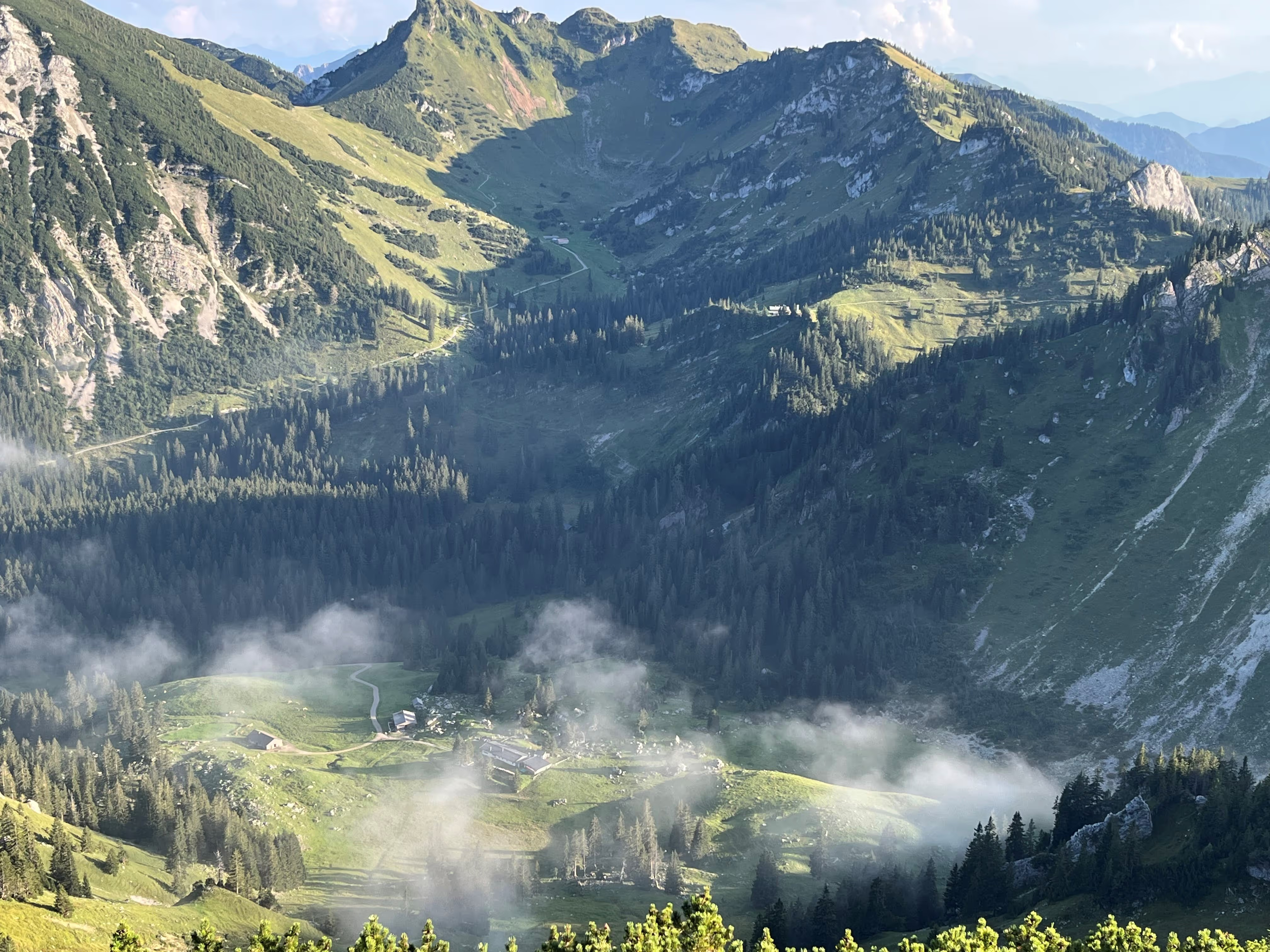
People searching for therapeutic fasting at Lake Tegernsee usually look for more than a beautiful lakeside scene. They look for a place where fasting has method, is medically carried, and leaves enough room to truly arrive. The region between Tegernsee, Schliersee and the Leitzach valley is among the quieter corners of Upper Bavaria: mountain ranges, alpine meadows, mountain streams and paths that invite walking at a pace that fits the fast. This pre-alpine landscape has long been a place people come to in order to find calm.
An honest placement right at the start: Tannerhof does not sit on Lake Tegernsee itself but southeast of it, in Bayrischzell in the upper Leitzach valley. For those who understand the region as a search area — Tegernsee, Schliersee and the Leitzach valley as one connected piece of Upper Bavaria — there is a family-run nature hotel here that has guided Buchinger therapeutic fasting medically for over 70 years. For guests interested in a medically guided fasting programme, Body Detox is the relevant page — the stay can also be booked online there. For method and dietary form in context, see the Therapeutic Fasting and Schlanke Tanne hub.
Buchinger therapeutic fasting is the conscious, time-limited abstention from solid food and stimulants. It is more than a diet and not a primary weight-loss method. It is a therapeutic method, cleansing on many levels and an encounter with oneself. Weight loss can be a side effect, but at the centre stand relief, a clear caesura, medical guidance and the slow rediscovery of a good eating rhythm. Two sentences shape the attitude of the house to this day: Otto Buchinger's fasting stimulates the inner physician and the handed-down words of Johannes von Mengershausen, In therapeutic fasting you discover a new freedom: independence from solid food. Fasting means stillness, listening inward and turning to what is essential.
The setting: Bayrischzell, Schliersee and the Leitzach valley
A fasting cure gains from the place that carries the process. Tannerhof sits in Bayrischzell, in the upper Leitzach valley, around 75 kilometres southeast of Munich, with a view into the valley and toward the Wendelstein. Schliersee is about 15 kilometres away, Rosenheim around 38, and Bayrischzell station just over a kilometre from the house. Munich and Salzburg airports are each about an hour and a half by car. So the house lies in the middle of the pre-alpine landscape between Wendelstein and Sonnwendjoch and remains easy to reach — for guests from Munich as well as from the Tegernsee valley, which lies a manageable distance away.
The place is not just location. It is the roughly 16 hectares of grounds, the mountain stream, the alpine meadows, the Lufthütten from 1905 and the four hut towers by Florian Nagler, the Orangerie as a long retreat beneath plants, the Fasterstube as a dining room of its own for fasting guests, and the BadeHarpfe with Finnish sauna, panoramic relaxation room, endurance and strength fitness area and the 25-metre outdoor natural pool that opens the view between Wendelstein and Sonnwendjoch. The paths by the house, the clear and pure mountain air and the mountain backdrop give fasting over several days a form of its own. People who fast here fast in my hideaway in the mountains — not in a clinic with a mountain panorama, but in a family-run nature hotel that explains, from long experience, what fasting is.
This region in particular invites coupling fasting with movement. For guests who like to combine fasting with quiet tours through the mountain landscape, Tannerhof offers the combination Hiking and Fasting. Walking at a pace that fits the fast is, for many, part of the real experience of these days. For an impression of how a tour in this landscape feels, the magazine piece Favourite Hike: the Seeberg Loop gives a sense.
Why people fast in this region
The motivations vary. Many guests seek a mental winding-down, a counterweight to overstimulation and constant acceleration. Others want relief from abundance, in which eating is reduced to the essentials — often with a more intense joy in eating afterwards. Still others come with a medical concern or with the wish to reorder their everyday life after fasting.
Behind these motives stands a well-documented research base. The Guidelines on Fasting Therapy come from the Medical Association for Fasting and Nutrition (ÄGHE), a society of physicians that grounds therapeutic fasting professionally. These guidelines, originally published as a consensus in 2002 and updated after 2013 as an expert panel update, describe methodology, patient selection, contraindications and medical accompaniment. They place its use under expert guidance for, among others, rheumatic conditions, high blood pressure, metabolic syndrome, allergies, autoimmune diseases, asthma, migraine, type II diabetes mellitus and depression. Studies on fasting therapy are also available through the ÄGHE.
How well longer fasting is tolerated is shown by a large observational study by Wilhelmi de Toledo and colleagues from 2019, published in PLOS One. It accompanied 1,422 people over fasting periods of four to twenty-one days following the Buchinger method. Severe adverse effects occurred in less than one percent; physical and emotional well-being rose markedly across all groups. Of the 404 participants with existing health complaints, 84.4 percent reported an improvement, and 93.2 percent of all participants experienced no hunger during fasting. Whether therapeutic fasting fits in an individual case still always belongs, at Tannerhof, to medical clarification.
Buchinger therapeutic fasting has a long tradition in Germany. Otto Buchinger developed his form of fasting in the early 20th century and carried fasting from folk medicine into a medically led method, which he described in his book Das Heilfasten und seine Hilfsmethoden. In southern Germany this tradition is firmly anchored — also at Tannerhof, which has carried Buchinger fasting through three generations of physicians.
What happens in the body: fat burning and autophagy
During fasting the body works on several levels. Two of them are often mixed up and should be clearly distinguished.
The first level is fat burning. When the quickly available carbohydrate stores decline, within the first days metabolism shifts from glucose to fatty acids and ketone bodies. This is the energetic side of fasting: the body increasingly draws its energy from its own reserves. In the PLOS One study this shift into ketosis could be shown through rising ketone bodies.
The second level is autophagy. It means not fat burning but the body's own recycling and cleansing processes at the cellular level: cell components are broken down, reused and reordered. How fundamental this mechanism is, the 2016 Nobel Prize in Physiology or Medicine shows, awarded to Yoshinori Ohsumi for the discovery of the mechanisms of autophagy. Put more vividly: all recycling processes are driven, cleaning happens everywhere — cellular, vascular, in connective tissue, in the gut, in the brain, in liver and kidneys.
Both processes occur together during fasting but describe different mechanisms. For certain metabolic and chronic concerns fasting can be medically interesting; whether it fits in an individual case belongs to the conversation with the medical team. Mental effects belong too. Often the need for sleep decreases while sleep itself becomes lighter. Some people experience a fasting euphoria from the altered serotonin metabolism, varying from person to person. Fasting creates a caesura and an abundance of time with and for oneself.
The course of a fasting week at Tannerhof
A fasting week does not begin only with the broth. Before arrival, the doctors at Tannerhof recommend one or more relief days at home, for example as a fruit, potato, vegetable or raw-food day — how many is for the guest to decide. The length of stay and the fasting package are already booked at this point. In the intake consultation on the first fasting day, the concrete course is agreed together within this frame and can be adjusted, in particular extended.
| Phase | Content |
|---|---|
| Arrival day and relief | Light vegetable plate for dinner. One or more relief days at home are recommended, for example as a fruit, potato, vegetable or raw-food day. |
| 1st fasting day: intake consultation and fasting start | First the medical conversation with history-taking, physical examination including bioimpedance analysis and medication review. Then, if suitable, the fasting start with Glauber's salt — the classic tool for beginning the fast — or another individually discussed method. |
| 2nd to 3rd day: transition | The body shifts noticeably; weakness, shakiness or headache may occur. Green tea with honey balances it out, and the medical team accompanies this phase. |
| Fasting days: five or more | Daily rhythm with tea, water, mild vegetable broth, freshly pressed juice and plenty of fluid. The longer one fasts, the deeper the effects. |
| Breaking the fast | Still counts as fasting time. It begins with the apple, raw or steamed, and very conscious chewing. |
| Rebuilding days | Gradual return to solid food and stimulants over roughly one third of the fasting time, with easily digestible vegetables, fermented foods and fibre. |
During the fasting days, herbal tea, water, lemon and ginger water, mild vegetable broth and freshly pressed fruit or vegetable juices carry the rhythm, with around three litres of fluid a day. In the evening, buttermilk or a plant-based protein source is added as desired, and if needed an alkaline preparation against acidic metabolic products and uric acid crystals. A spoonful of honey or an espresso may bridge a low point without leaving the character of the fast. The fasting guests take their meals in the Fasterstube, the dining room of their own for fasting guests. This seems small but is essential: someone who fasts needs a different beat than someone enjoying a full menu.
Movement remains part of fasting, measured in dose. Moderate basic endurance training and moderate strength training are available, as are yoga, Feldenkrais, Tai Chi, Theraband training and breathing therapy. Summit tours and running are possible, only at a pace that fits the fast — the body nourishes itself from within. So the mountain landscape around Bayrischzell becomes part of the process, not a backdrop beside it.
Medical guidance as Tannerhof practice
Medical guidance is not strictly mandatory for fasting, but it makes sense. At Tannerhof therapeutic fasting is always medically guided, because here the house's medical experience belongs together with the fasting process. The doctors at Tannerhof are experts in fasting; they accompany values and circulation as well as the individual course. Setting and medical guidance work as equals: fasting in a moving landscape becomes more intense, and the guidance gives the process direction.
The medical appointments form a quiet arc. At the beginning stands the intake consultation on the first fasting day. It is holistic: history-taking, physical examination including bioimpedance analysis to measure body composition and medication review belong to it, as do the questions of why someone fasts, what goals at Tannerhof exist besides fasting, what is happening in life right now and what fasting experience already exists. Every person is different; the individual stands at the centre. If needed, a medical follow-up consultation follows. At the end stands a closing consultation, in which it is evaluated what has changed, which recommendations fit everyday life and how the transition into nutrition afterwards can look. Billing for medical services runs through the private practice at Tannerhof.
The accompanying treatment offering is deliberately broad, because fasting is more than a dietary change for a few days. The medical applications include bioimpedance analysis, IHHT altitude training depending on the programme and, when medically suitable, ozone autohaemotherapy. Added to this are wraps and compresses such as the liver-supporting hay flower wrap, aromatic wraps as well as mud and warm packs, baths and affusions such as the Kneipp alternating affusion and magnesium-rich detoxifying baths, plus massages such as the fasting massage, the detoxifying massage with king's oil or the acidosis massage, lymphatic drainage and foot reflexology, complemented by breathing therapy. For the mental side, psychotherapeutic coaching, nature coaching, business and communication coaching and art therapy accompany the process. Fasting experience is anchored throughout the house, from reception through the restaurant to the practitioners. For those who want to see the frame and book online, it is detailed in the programme Body Detox.
Breaking the fast, rebuilding and Schlanke Tanne
Rebuilding is not the postscript of fasting but its continuation by other means. Breaking the fast still counts as a fasting day: at midday a small cup of faster's broth, then the apple, raw or steamed, every bite chewed thirty to forty times. In the evening a vegetable soup with un-puréed vegetable pieces follows. Someone who takes five fasting days usually needs two rebuilding days; with seven fasting days the rebuilding grows to two or three days, in total roughly one third of the fasting time.
At the centre stands not a complicated meal plan but the guiding question of what is good for the microbiome: easily digestible vegetables, fermented foods, plenty of fibre and mindful chewing, with respect for the feeling of fullness. In the closing consultation with the accompanying doctors, nutrition afterwards is also discussed. If a sustainable change is wanted, Schlanke Tanne Low Carb can follow, the in-house low-carb form. It is no replacement for Buchinger but a way to carry fasting experience into everyday life — with protein, vegetables, good fats and the aim of eating differently again without diminishing the joy in eating. When the gain in enjoyment and joy of life replaces the language of abstention.
Intermittent fasting, for example in a 16/8 rhythm, is in turn no replacement for Buchinger but the recommended form for carrying the benefits of compact fasting into everyday life. Schlanke Tanne Intervall can be a Tannerhof path for this. So a fasting week in the region becomes more than a brief abstention. It gains a beginning, a middle and a transition. Perhaps that is exactly the old Tannerhof phrase in today's form: Become essential.

Who can fast and who needs medical clarification
What matters for fasting are one's own will and the readiness to engage with it. During pregnancy, breastfeeding and anorexia, therapeutic fasting does not belong in the plan. With chronic conditions, ongoing medication or uncertainty, a telephone medical pre-consultation can be requested before arrival; what remains decisive is then the intake consultation on the first fasting day.
How long one fasts is a recommendation, not a rule. At Tannerhof five fasting days and upward are recommended, because otherwise the transition gets little room. For first-time fasters a week is fine: about seven fasting days plus two to three rebuilding days, around ten days in total. With health concerns gladly longer, with close medical guidance. In the end a good week of time comes together, which one should take.
Discovering therapeutic fasting in the Tegernsee region at Tannerhof
Naturhotel Tannerhof has offered Buchinger therapeutic fasting for over 70 years: medically guided, experienced in fasting throughout all departments, and embedded in Bayrischzell, southeast of Lake Tegernsee, between alpine meadow, mountain stream and the view toward the Wendelstein. For those who want to see the concrete frame and book online, it is found in the programme Body Detox, in the Therapeutic Fasting and Schlanke Tanne hub and in the combination Hiking and Fasting.
FAQs
At Naturhotel Tannerhof in Bayrischzell, southeast of Lake Tegernsee near Schliersee, Buchinger therapeutic fasting has been offered under medical guidance for over 70 years. The house sits in the upper Leitzach valley with a view of the Wendelstein, about 15 kilometres from Schliersee and around 75 kilometres from Munich. The relevant programme is Body Detox, bookable online.
No. Tannerhof sits in Bayrischzell, southeast of Lake Tegernsee, in the upper Leitzach valley between Wendelstein and Sonnwendjoch. Schliersee is around 15 kilometres away, and the Tegernsee valley lies a manageable distance off. For those who understand the pre-alpine region as a search area, there is a family-run nature hotel here with a long fasting tradition.
Online booking is available. Stay levels, arrival days and prices are on the Body Detox programme page. The length of stay and the treatment package are booked before arrival; in the intake consultation on the first fasting day, the concrete daily plan is arranged individually within this frame.
During the fasting days there is no solid food or stimulants. The rhythm consists of herbal tea, water, lemon and ginger water, mild vegetable broth, freshly pressed fruit or vegetable juices and, if needed, supplementary protein sources or an alkaline preparation, in total around three litres of fluid a day.
Two processes run at the same time. Metabolism shifts from glucose to fatty acids and ketone bodies, that is, to fat burning. In parallel run autophagy processes, the cellular recycling, for whose discovery Yoshinori Ohsumi received the 2016 Nobel Prize in Medicine. The two processes are to be distinguished.
Yes. In the pre-alpine region around Bayrischzell it lends itself to this: walking at a pace that fits the fast is, for many, part of the real experience. Tannerhof offers the combination Hiking and Fasting for this, embedded in the landscape between Wendelstein and Sonnwendjoch.
Sources
- Medical Association for Fasting and Nutrition (ÄGHE): Guidelines on Fasting Therapy (Consensus 2002, Expert Panel update after 2013).
- Wilhelmi de Toledo F., Grundler F., Bergouignan A., Drinda S., Michalsen A.: Safety, health improvement and well-being during a 4 to 21-day fasting period in an observational study including 1422 subjects, PLOS One, 2019.
- The Nobel Prize in Physiology or Medicine 2016, Yoshinori Ohsumi: for his discoveries of mechanisms for autophagy.
- In-house sources: Naturhotel Tannerhof, Body Detox, Therapeutic Fasting and Schlanke Tanne and Hiking and Fasting.
Note
This article describes the approach and practice of Naturhotel Tannerhof regarding therapeutic fasting in the region between Tegernsee, Schliersee and the Leitzach valley. It does not replace individual medical advice. A telephone medical pre-consultation is available on request.
Health programs at Tannerhof

Body Detox Fasting

Mental Resilience
Longevity

Immune Booster

Aesthetics

Nutrition
"I feel a lightness I have missed for a long time"
ELLE Magazine