Breaking the Fast and Refeeding Days Done Right
How breaking the fast begins with the holy apple, why refeeding runs over about a third of the fasting period, and how the transition back into everyday life succeeds – a calm guide from Naturhotel Tannerhof.

Breaking the fast begins with an apple, raw or steamed, every bite chewed thirty to forty times. It still counts as part of the fasting period. The refeeding days follow over about a third of the fasting period, during which the body is gradually led back to solid food and stimulants. At Naturhotel Tannerhof this transition is medically supervised.
The essentials at a glance
- Breaking the fast is not an endpoint but a deliberate step of its own: a small cup of fasting soup at midday, then the apple, raw or steamed.
- Mindful chewing carries this transition – every bite thirty to forty times, with respect for the feeling of fullness.
- Refeeding runs over about a third of the fasting period: two refeeding days after five fasting days, two to three after seven.
- The guiding question of refeeding is: what is good for the microbiome? Easily digestible vegetables, fermented foods, and plenty of fibre.
- After refeeding, the path leads back into everyday life, for example via the Schlanke Tanne Low Carb, the house's own low-carb way of eating.
Why breaking the fast matters so much
Anyone who has lived through a fasting week tends to associate fasting with the days of going without. Yet perhaps the decisive part comes afterwards. Breaking the fast and the refeeding days are the moment when the value of a fasting week is secured – or squandered. In fasting medicine, this phase is considered more demanding than the fast itself, because the body has to be led slowly and carefully out of the fasting metabolism.
At Naturhotel Tannerhof, refeeding is therefore part of fasting from the very start, not as an afterthought but as a continuation by other means. Therapeutic fasting according to Buchinger is the deliberate, time-limited abstention from solid food and stimulants – and the return to them is just as deliberate. Anyone who would like to see the medically supervised setting at the house or book it online will find it in the Body Detox programme; the method itself is described on the page on therapeutic fasting according to Buchinger.
That this transition carries so much weight is well documented. In the large observational study by Wilhelmi de Toledo and colleagues, published in PLOS One in 2019, more than 1,400 fasting participants following the Buchinger method had food gradually reintroduced from the last fasting day, on average over about four days, with an ovo-lacto-vegetarian diet rising from 800 to 1,600 kilocalories per day. Refeeding is therefore not a loose appendage but an integral part of the method.
Breaking the fast with the holy apple
At the Tannerhof, breaking the fast still counts as a fasting day. At midday a small cup of fasting soup is on the table, that mild vegetable soup that has carried people through the fasting days. And then comes the apple – affectionately called the holy apple at the house, because it ushers in the transition. It comes to the plate raw or steamed, depending on what feels better at the moment.
The apple is a clever first solid food. It brings a little sweetness, plenty of water, and, with its pectin, a gentle fibre that slowly wakes the gut again. What matters is not only what is eaten but how. Every bite is chewed thirty to forty times, slowly, mindfully, and without haste. In this way digestion already begins in the mouth, the saliva prepares the food, and the body is given time to remember the work it has paused for days.
In the evening a vegetable soup follows, this time with un-pureed pieces of vegetable. This is a deliberate step: where everything was still soft and liquid at midday, now for the first time something to bite into comes to the plate. The day of breaking the fast is thus a small choreography of its own – soup, apple, soup with pieces – that brings the body back step by step.

Mindful chewing: thirty to forty times
Thorough chewing is not an accessory but the principle that carries the whole of refeeding. After days in which the digestive system has come to rest, hasty eating would overwhelm it. Anyone who chews slowly and thoroughly gives the body back the lead.
Three things happen at once:
- The food is finely broken down, so that the stomach and gut have less work to do.
- The saliva joins in and begins digestion already in the mouth.
- The feeling of fullness is given time to make itself known – after fasting it is often finer and felt earlier than before.
This last observation is one of the loveliest experiences of refeeding: many guests sense how little is enough and how intensely that little tastes. This is why a simple rule applies to the refeeding days: respect the feeling of fullness and stop when you are full – even if the plate is not yet empty.
Refeeding over about a third of the fasting period
After breaking the fast, the actual refeeding days begin. Their length is not governed by a fixed number but by the duration of the fast. The rule of thumb shared by both Tannerhof practice and the fasting literature is: refeeding takes up about a third of the fasting period. Anyone who has fasted for five days usually needs two refeeding days; after seven fasting days, refeeding grows to two or three days.
| Fasting days | Refeeding days (≈ 1/3) | Character of the days |
|---|---|---|
| 5 days | 2 refeeding days | Gentle start, light food, plenty of chewing |
| 7 days | 2 to 3 refeeding days | Gradual expansion up to fish |
| 10 days and more | correspondingly longer, medically tailored | Closely supervised, individually adapted |
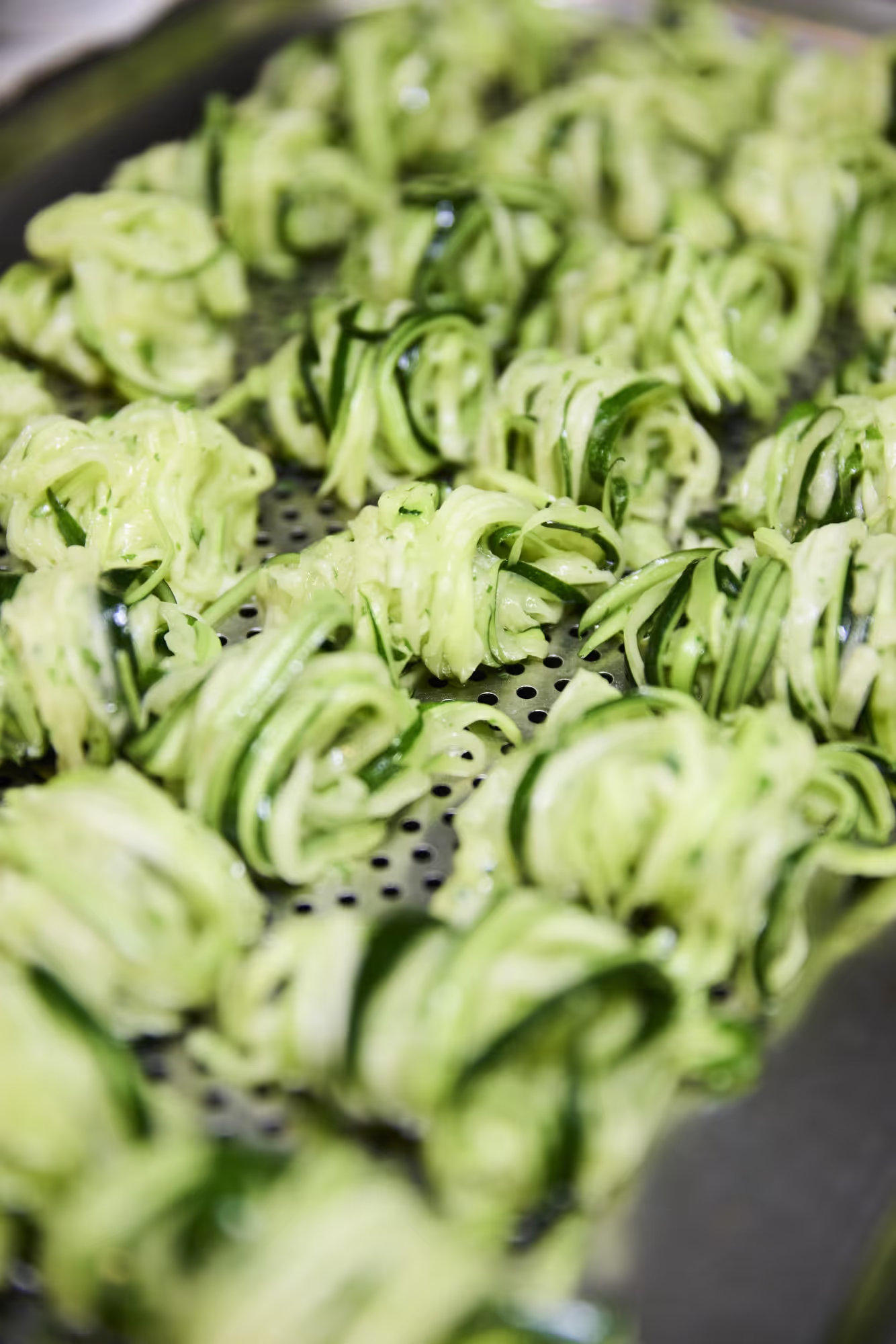
During these days, solid food and stimulants return step by step. A typical refeeding day begins with a breakfast of yoghurt, linseed, and soaked prunes. At midday there is light vegetable fare on the menu, salads, a vegetable soufflé, or stuffed courgettes, and later fish is added too. In the evening comes the small vegetable plate of the Schlanke Tanne with varying protein, such as tofu, sheep's cheese, or egg. More important than the exact menu is the guiding idea behind it: slowly, lightly, calmly.
The doctors and the fasting-experienced team at the Tannerhof keep the detailed daily plan ready for guests on site. In the intake consultation on the first fasting day and over the course that follows, the refeeding rhythm is discussed together with the fasting guest, because each person tolerates the transition a little differently.

The guiding question of refeeding: the microbiome
Behind the plates of the refeeding days stands a single, clear question: what is good for our microbiome? This means the community of microorganisms in the gut, which is placed in a special situation during fasting and now wants to be carefully supplied again. This guiding question leads more reliably through the refeeding days than any rigid list.
From it follow three priorities:
- Easily digestible vegetables that do not overwhelm the gut.
- Fermented foods that supply the microbiome with friendly bacteria.
- Plenty of fibre that serves as food for the good gut bacteria.
Equally clear is what does not yet belong on the plate in this phase. Nothing with chilli, nothing with garlic, nothing with onion, nothing with pepper – anything that sharply irritates or sits heavily in the stomach must still wait. The freshly woken digestive system should be given substance, not irritation. In this way the return to eating becomes refeeding in the truest sense: layer by layer, from the light to the more robust.
Movement, treatments, and medical supervision during refeeding
During the refeeding days too, the Tannerhof setting stays the same as in the fasting week, except that the body slowly receives more substance again. Movement is part of it, modestly dosed: moderate basic endurance training and moderate strength training, plus yoga, Feldenkrais, tai chi, Thera-Band training, and breathing therapy. A walk or a sauna session at a calm pace fits well into these days, because the body is still nourishing itself to some extent from within.
The accompanying range of treatments is deliberately broad, because the transition is more than a question of the menu. The medical treatments include bioimpedance analysis to measure body composition, IHHT altitude training depending on the programme, and, where medically appropriate, ozone autohaemotherapy. Added to these are compresses and wraps such as the liver-supporting hayflower wrap, aroma wraps, and mud and warm packs, baths and douches such as the Kneipp alternating douche and magnesium-rich detox baths, massages such as the fasting massage, the detox massage with King's oil, or the acidosis massage, lymphatic drainage and foot reflexology. For the mental side, psychotherapeutic coaching, nature coaching, business and communication coaching, and art therapy provide support.
Medical supervision completes the arc. At the end of the fasting week there is a closing consultation with the attending doctors, in which it is reviewed what has changed, which recommendations suit everyday life, and how the transition into the diet afterwards might look. The doctors at the Tannerhof are experts in fasting, and refeeding is the phase in which this experience pays off in particular. Surroundings and medical supervision work as equals: Bayrischzell, the alpine meadow, the mountain stream, the clear and pure mountain air, and the view of the Wendelstein give the transition its calm frame. My hideaway in the mountains is exactly this frame.
The transition into everyday life: Schlanke Tanne and intermittent fasting
With the last refeeding day the fasting week ends, but not its effect. So that what began during fasting is preserved in everyday life, the Tannerhof recommends a gentle continuation. After refeeding, at least one more week in a calm eating rhythm is good, for example via the Schlanke Tanne Low Carb, the house's own low-carb way of eating, in its Schlanke Tanne Drei variant or as intermittent fasting.
The Schlanke Tanne is not a substitute for Buchinger but a way to carry the fasting experience into everyday life – with protein, vegetables, good fats, and the idea of eating differently again without diminishing the joy of eating. When the gain in enjoyment and joy of life, rather than going without, takes centre stage. Intermittent fasting too, for example in a 16/8 rhythm, belongs to this logic: it is not the multi-day compact fasting according to Buchinger but the recommended way to carry its benefits into everyday life.
Which follow-on diet suits the individual case does not belong in a general formula but in the closing consultation with the attending doctors. An overview of therapeutic fasting and the Schlanke Tanne Low Carb is given by the hub Therapeutic Fasting and Schlanke Tanne. In this way a fasting week is given what makes it durable: a beginning, a middle, and a transition that leads back into life.
FAQs
Breaking the fast still counts as a fasting day. At midday a small cup of fasting soup is on the table, followed by the apple, raw or steamed, every bite chewed thirty to forty times. In the evening there is a vegetable soup, this time with un-pureed pieces of vegetable. In this way the body is led back to solid food step by step.
The apple is a mild, well-tolerated first solid food. It brings a little sweetness, plenty of water, and, with its pectin, a gentle fibre that slowly wakes the gut again. What matters is thorough chewing: every bite is chewed thirty to forty times, so that digestion begins already in the mouth.
As a rule of thumb, refeeding takes up about a third of the fasting period. After five fasting days that is usually two refeeding days, after seven fasting days two to three. For longer fasting periods, refeeding lengthens accordingly and is medically tailored. More important than the exact number is the gentle, gradual character of these days.
The guiding question is: what is good for the microbiome? Easily digestible vegetables, fermented foods, and plenty of fibre come to the plate, and later fish and a varying protein such as tofu, sheep's cheese, or egg. Not yet suitable is anything spicy, garlicky, oniony, or peppery. Eating is done slowly, with respect for the feeling of fullness.
After several fasting days, the digestive system has come to rest. If it were now overwhelmed with abundant or heavy food, part of the fasting effect would be lost. The slow, mindful refeeding leads the body gently back and secures what the fast began. This is why fasting medicine regards this phase as the more demanding part.
After refeeding, a gentle transition into everyday life is recommended, for example via the Schlanke Tanne Low Carb in its Schlanke Tanne Drei variant or as intermittent fasting. Which follow-on diet suits the individual case is discussed in the closing medical consultation. In this way the fasting effect is preserved beyond the fasting week.
Sources
- German Medical Society for Therapeutic Fasting and Nutrition (ÄGHE): Guidelines on fasting therapy (consensus 2002, update 2013), with details on rebuilding the diet after the fasting period.
- UGB health counselling: Breaking the fast and refeeding days – the apple for breaking the fast, chewing, and the rule that refeeding takes up at least a third of the fasting period.
- Wilhelmi de Toledo F., Grundler F., Bergouignan A., Drinda S., Michalsen A.: Safety, health improvement and well-being during a 4 to 21-day fasting period in an observational study including 1422 subjects, PLOS One, 2019 – describes the gradual reintroduction of food over about four days from 800 to 1,600 kcal.
- In-house sources: Naturhotel Tannerhof, Body Detox and The Buchinger Method.
Note: This article describes breaking the fast and refeeding after therapeutic fasting according to Buchinger, as well as the attitude and practice of Naturhotel Tannerhof. It does not replace individual medical advice. A telephone medical pre-consultation is available on request.
Health programs at Tannerhof

Body Detox Fasting

Mental Resilience

Longevity

Immune Booster

Aesthetics
Nutrition
"I feel a lightness I have missed for a long time"
ELLE Magazine